
How to Guide 209

Azlactone Coating

How to Guide 209 • HG209R3
22 Mar 2022 •  © 2022 Sapidyne Instruments Inc.

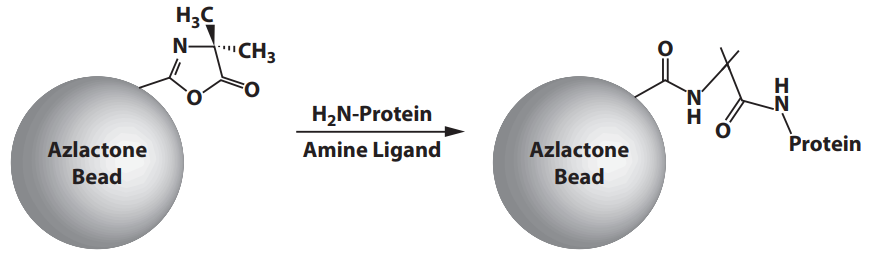
Covalent immobilization of a molecule may result in higher signals than with adsorption coating, as well as reduce the amount of molecule necessary. If the molecule contains a free primary amine, Azlactone beads (Sapidyne Part #: 444110) can be used. The coupling is spontaneously reactive and forms a stable bond with amines (Figure 1).

  1. Dry Azlactone beads should be stored at 4°C in a desiccator. Any moisture will cause the beads to hydrolize making them less efficient.
  2. To a 50 mg aliquot of Azlactone beads, add 1 mL of the coating solution. This solution consists of 10-20 µg/mL molecule in 50 mM Sodium carbonate + 0.5 M Sodium citrate buffer, pH 9.0-9.6. Make sure the beads are fully suspended in solution.
  3. Rock/tumble bead vials at room temperature for 1 hour or overnight at 4°C.
  4. Allow the beads to settle or pulse centrifuge at a low speed to pellet the beads. Discard the supernatant without disturbing the settled beads.
  5. Add 1 mL of the blocking solution. This solution consists of 10 mg/mL BSA in 1 M Tris buffer, pH 8.0-8.5. Make sure the beads are re-suspended in blocking solution.
  6. Rock/tumble bead vials at room temperature for 30 minutes or overnight at 4°C.
  7. Store in blocking solution at 4°C until ready for use.

Notes:

  • Before starting an experiment, be sure to Edit the Bead Handling to “Soft Beads”. Keep all flow rates at or below 1 mL/min in the sample timing.
  • Larger sample volumes (greater than 4 mL) should be avoided, as the flow cell screen will clog faster over time.
  • Coupling is more efficient at a higher pH (9.6), provided that the protein to be coupled can withstand these conditions.
  • Amine-containing buffers (Tris, Glycine, or BSA buffers) must not be used in the coupling step because their amine functional groups will compete with the protein for coupling sites.

Figure 1. Covalent protein immobilization on Azlactone beads. Azlactone rings react with primary amines on proteins to form highly stable amide bonds, coupling the molecule to the bead.

KinExA® is a registered trademark of Sapidyne Instruments Inc.