
Newsletter #11

Temperature Measurements
With the release of the TC1000, KinExA users are now able to run experiments at temperatures ranging from 4°C to 40°C. While useful for characterizing biological interactions, there are some things to consider when changing temperature.
Equilibrium & Kd shifts
Samples need to equilibrate at the temperature at which they are being evaluated. This means that samples prepared on the bench need to reach the temperature inside the TC1000 and then reach binding equilibrium at that temperature. Small samples reach temperature more quickly than large samples. Make sure to give samples enough time to reach temperature in addition to equilibration time when calculating incubation time needed.
Kd values are temperature dependent. We have routinely seen Kd’s get weaker with higher temperatures but that is not always the case. If you have a system that you measured at room temperature, do not expect the same results at other temperatures. If the Kd becomes tighter, constant binding partner (CBP) and titrant concentrations may need to shift down to accurately define the Kd. Conversely, if the Kd becomes weaker, you may need to use higher concentrations. Note that CBP concentrations need to stay in linear range and if working with weaker Kd’s, make sure you are still in the KinExA Mode. Refer to TN224 Linear Range and TN221 KinExA Mode for more information.
Condensation
Switching from 4°C to warmer temperatures can cause condensation in the instrument. Normally, if the TC1000 remains closed until the new temperature is reached, condensation will not be an issue. Note: the buffer in the reservoir will take much longer to reach the new temperature. To ensure condensation does not affect the instrument, and that buffer is at the right temperature, change the temperature at the end of the day. The instrument and buffer will be ready the next morning.
Evaporation
Small Volume Tubes (P/N: 111642) are often used for small sample volumes and to reduce dead volume needed. According to TN206 Minimum Sample Volume, as little as 10 μL is sufficient for dead volume for an experiment duration of 5 hours at room temperature. That will not be the case at 37°C; evaporation happens more quickly so additional volume should be added. While we recommend a minimum of 50 μL dead volume, less can be evaluated and potentially used.
Samples should be covered during equilibration. This is true at any temperature. Foil Tape (P/N: JVCCAF20) or scotch tape are good options, but do not use Parafilm. When the experiment starts, the sample tip will pierce the tape to access the sample. As the experiment progresses, there is a hole that allows sample to evaporate. If that is a concern due to small samples, consider preparing the titration series and then splitting them in half to aliquot into additional tubes. Cover all samples and adjust the sample set to sample each tube once.
Temperature Tolerant Parts
The XP and XCalibur Pumps used on 3X00 and 4000 KinExA models come standard with plastic XP or XCalibur Valves. In order to avoid the temperature effects of plastic pieces, Ceramic XP Valves (P/N: 310136) or Ceramic XCalibur Valves (P/N: 310131) will need to be used. Syringe barrels that contain a plastic piston should also be replaced with Temperature Tolerant Syringe Barrels (P/N: 310510). It is important that these Valves are in good working condition to prevent leaks that may lead to bubble and sample draw issues.
Note: These parts are included with the purchase of a TC1000.
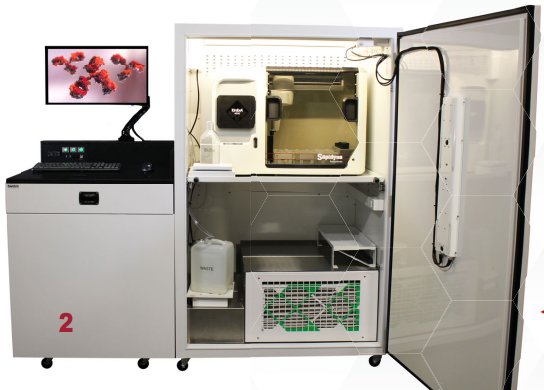
TC1000 with KinExA 4000
Tube Rotator
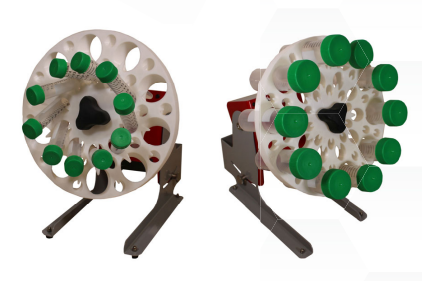
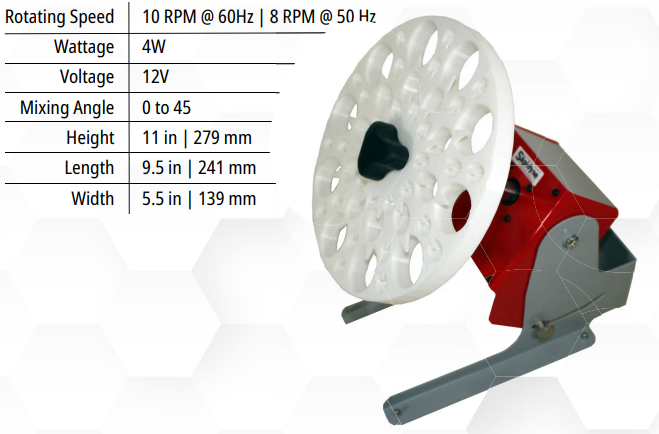
Our tube rotator was designed to optimize KinExA experiment preparation. It employs gentle and effective mixing with an adjustable angle that optimizes mixing for any sample. The compact design is small enough to fit on a crowded bench, in an incubator, or under the hood. Purchase includes the base unit, power cord, one tube roller mixing rotor, and one end-over-end mixing rotor. Rotors can hold up to ten 50 mL tubes, ten 5 or 15 mL tubes, and up to 30 micro volume tubes.
Tips & Tricks
Aspiration Pump Syringe Purge
Sapidyne’s latest software release, KinExA Pro version 4.5, includes a new feature called the Aspiration Pump Syringe Purge. As the name suggests, this feature allows you to “purge” your instrument’s syringe barrel of those little bubbles that sometimes cling to the top of the syringe. Keeping air out of the system helps in getting clean and accurate data.
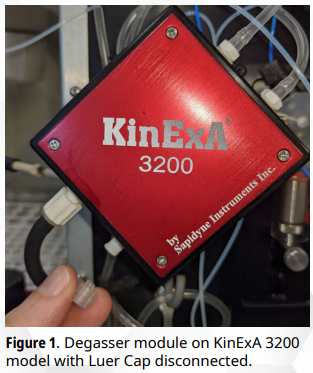
To purge the syringe open the Instrument tab, click on the “Syringe Purge” button, then click “Start”. If you are using a 3200 model, the software will ask you to loosen the Luer cap on the degasser module until the vacuum pump engages, then retighten the cap (see Figure 1). The KinExA 4000 can engage the vacuum pump through software alone, but the 3200 needs you to release some pressure to engage the vacuum pump. Afterwards, both models will automatically perform the syringe purge and inform you when it is complete (about 2 minutes). This feature only exists on KinExA Pro software version 4.5 and newer.
Publication Spotlight
Development of a potent high-affinity human therapeutic antibody via novel application of recombination signal sequence–based affinity maturation
Agnieszka Kielczewska, Igor D’Angelo, Maria Sheena Amador, Tina Wang, Athena Sudom, Xiaoshan Min, Palaniswami Rathanaswami, Craig Pigott, Ian N. Foltz. DOI: https://doi.org/10.1016/j.jbc.2021.101533
In a recent publication from Amgen, researchers used mammalian recombination signal sequence (RSS) as an affinity maturation method to improve the Kd of an antibody-antigen interaction. This method was able to produce lead antibodies ranging from 12 pM to 34 fM (Figure 2). Measuring interactions this tight can be challenging, even with the KinExA instrument.
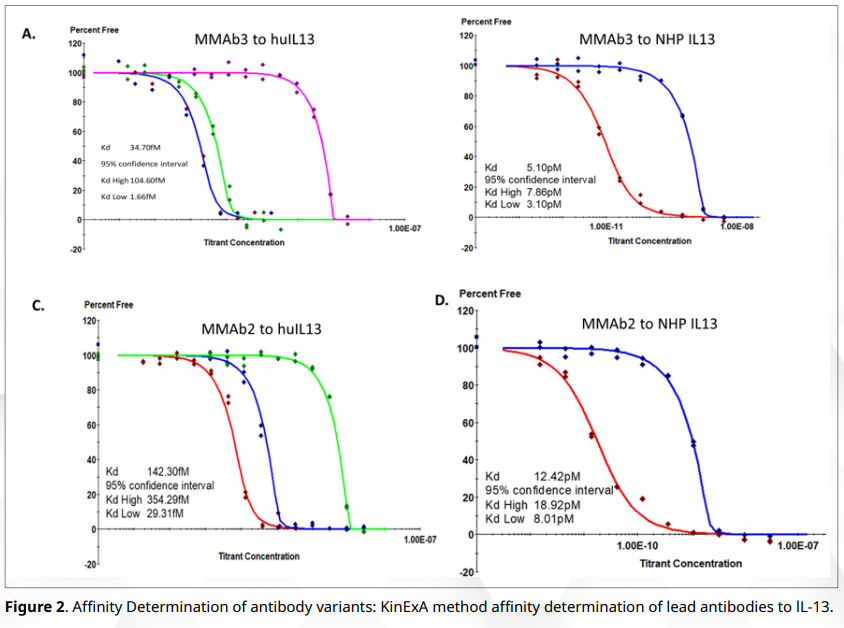
The scientists at Amgen were able to achieve this by using multi curve analysis, and paying attention to the ratio (CBP concentration to Kd) of the binding curves. As discussed in a previous publication,1 it is important that the active binding site concentration be near or below the actual Kd for accurate Kd measurements. A CBP concentration as low as 50 fM was able to be measured, allowing for defined 95% confidence intervals. For the data shown in Figure 2, a 1:1 binding model was used to fit theory curves to the data. Each curve shows a good fit both in terms of shape and spacing of the curves. The 34 fM Kd measured here is the tightest antibody Kd published to date using the KinExA Instrument.
- P. Rathanaswami et al. / Biochemical and Biophysical Research Communications 334 (2005) 1004–1013
Ask the Inventor
Question
Why do measurements need to be performed with signals in the linear range? How will equilibrium & kinetic data be affected outside of the linear range?
 Answer
When the KinExA Pro analysis converts binding signals (volts) into free Constant Binding Partner (CBP) concentrations (molar), it does so in part by assuming the signal is directly proportional to the free CBP concentration. Signals are generated by binding free CBP to Titrant coated solid phase and the linearity of response is based on an assumption that the binding is first order, meaning the fraction of solid phase Titrant that is bound is an insignificant fraction of the total solid phase Titrant. The KinExA linearity test (see TechNote 224 Linear Range for details) is a method validating the assumption, and provides guidance for the maximum CBP concentration that should be used with the specific beads and timing tested. As part of the Linear Range test, a hyperbolic equation (Equation 1) is fitted to measured data to get estimates for the A and B parameters.
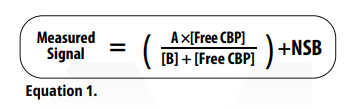
Where: A = maximum saturation signal, B = concentration that produces half of the max signal, NSB = non specific binding signal.
The maximum CBP concentration Sapidyne recommends is 0.2×B which is illustrated in Figure 3.
My guess is that none of my readers will object that Sapidyne’s recommendation is not linear enough but that some will think it’s too conservative and higher CBP concentrations could be used without problems. I acknowledge that 0.2×B is a judgment call on our part and not a hard and fast rule. With that in mind, I constructed a series of simulations to give you a sense of how much error you can expect in your Kd and kon determinations for a variety of B factors (=CBP/B) should you choose to operate outside our guidance. I simulated a dual curve system with a Kd of 1 nM and CBP concentrations of 5 and 50 nM. I looked at B factors ranging from 0.01 to 5 which I implemented by changing B rather than changing the CBP. For each B factor I simulated hyperbolic signals, then added pseudorandom noise (3% of Sig100) and then solved for Kd using the standard KinExA Pro analysis. I repeated with a minimum of 50 and up to 1000 different random noise sets and then averaged the Kd value and the confidence intervals. The results are shown in Figure 4 (equilibrium dual curve) and Figure 5 (kinetics direct).
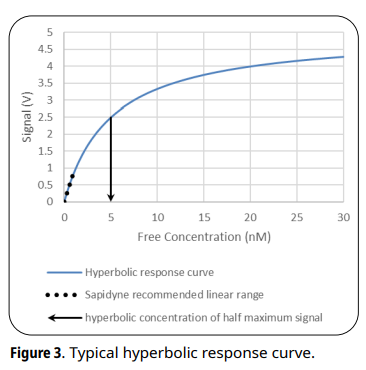
Note: The effect of the hyperbolic response is that signals are higher than they would be if the response was linear. Curves are shifted toward the right and made steeper the larger the CBP concentration is relative to B (See Tech Note 224 Linear Range for some examples). This means that curves measured with ratios that would normally easily resolve the Kd, for example a ratio of 20, may be analyzed as much higher ratios and fail to resolve the Kd. I saw this in simulations using a 200 pM low curve either alone or with a 20 nM high curve.
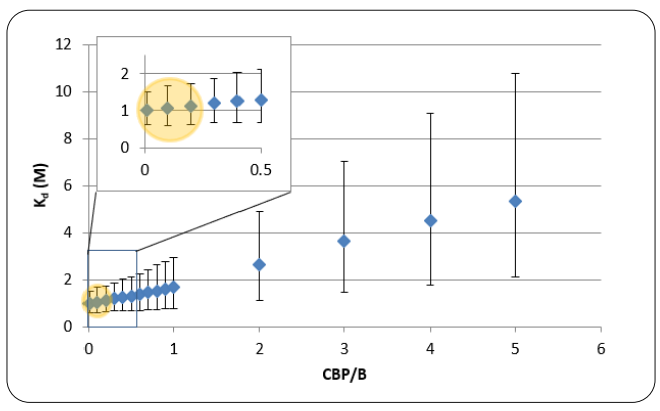
Figure 4. The factor of error in reported Kd value vs. the CBP concentration expressed as a fraction of B, the concentration of half maximum for the hyperbolic response. As an example, if the CBP concentration is equal to B (1 on the x axis) you can expect a factor of error between 1 (no error) and approximately 3x. The reported Kd’s are generally weaker than actual. The yellow circle represents Sapidyne’s recommended range of operation, CBP/B <=0.2.
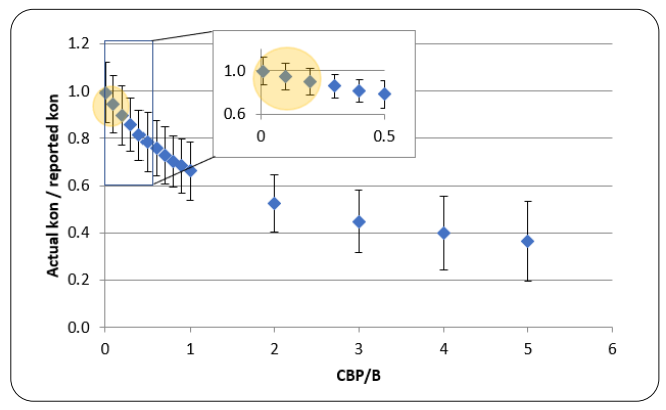
Figure 5. The factor of error in kon as a function of the CBP expressed as a fraction of B. For example, if the CBP is equal to 2*B (2 on the x axis) the expected range for the reported kon is between approximately 0.4 and 0.65 times the actual kon. Reported kon values are expected to be slower than actual. The yellow circle represents Sapidyne’s recommended range of operation, CBP/B ≤ 0.2.
Conclusions
Sapidyne’s guidance is to operate at a concentration of 0.2×B or less. As you can see in Figures 4 and 5 it is a case of the “lower the better”. In many cases this means you are operating with Sig100 levels of less than a volt (itself a rule of thumb at Sapidyne). Many users prefer large signals but studies conducted at Sapidyne (see TechNote 228 “Signal vs Signal/Noise”) show that raising signals above 0.5 volts is not productive in terms of Kd accuracy.
Finally, if an experiment must be conducted using concentrations with a higher percentage of the B factor the error can be corrected by submitting the sanitized .kxp file along with the hyperbolic signal test to a Sapidyne representative.
Geek Corner
Autosampler Calibration Wizard
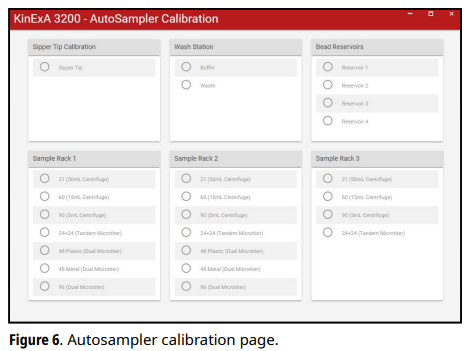
To achieve proper sampling during experiments and to avoid collisions with the sipper tip, the autosampler must be calibrated. In software versions 4.5.X and higher, improvements have been made that make this process easier. Previously, users were left to define calibrations independently and through numerical grid positioning.
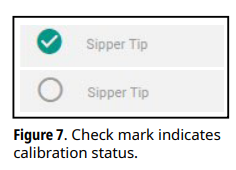
To calibrate the autosampler, navigate to the tools bar, drop to calibration and designate Autosampler. A screen, shown in Figure 6, will appear with lists of everything that can be calibrated. Positions that have saved calibrations will be marked by a green check and un-calibrated positions will have an empty circle (Figure 7).
To calibrate a specific position, click on it and the calibration wizard (Figure 8) will guide you through the calibration process. Follow the directions on the calibration wizard pop-up, and click next when completed.
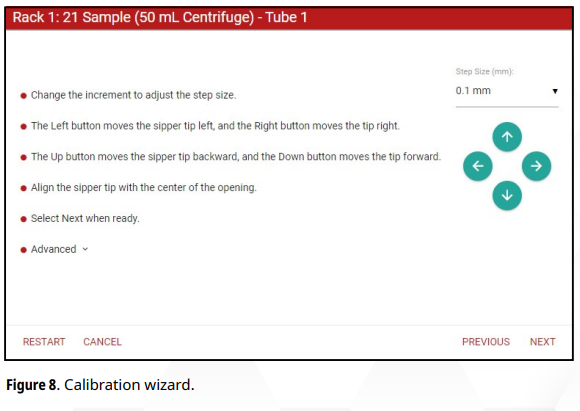
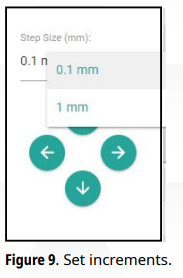
What makes the new calibrations significantly easier than previous software versions, is the ability to direct the sipper tip using arrows and also to change the increment in which it moves. Using the green arrows, the sipper tip can be directed towards the center of the position of interest. The bottom most arrow will direct the sipper tip towards the user with all others following this directionality. Using the drop down menu above the arrows, the increment of movement can be changed (Figure 9), from 0.1 to 1 mm. If necessary, the advanced tab on the left of the page can be opened to provide more information or restore default locations. This tab is generally not needed for autosampler calibration and shouldn’t be necessary in most cases.