Newsletter #12


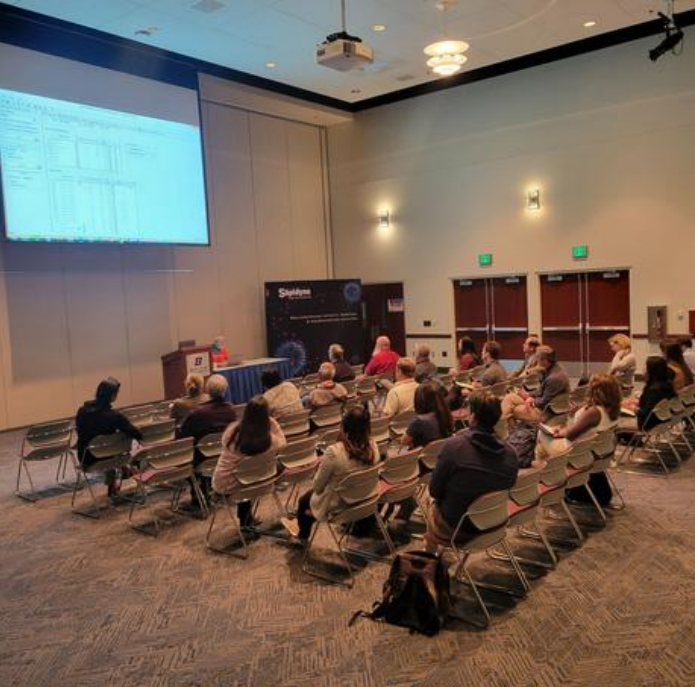
The KinExA Seminar was a huge success. The collaborative interaction was better than we could have imagined. For two days scientists challenged theories, learned techniques, and presented data. Thank you to all who attended. KinExA applications and knowledge continue to thrive thanks to our users.
—Liz Hopkins, President and CEO

Dr. Ching Chen
Senior principal scientist at Amgen, presented her study on integral membrane proteins. Dr. Chen discussed the following:
- Bimolecular interaction analysis and label free technologies in drug discovery and development.
- Major integral membrane proteins (IMP), functions, and mechanism of action.
- Binding analysis of therapeutic antibody to IMP using cell membranes and KinExA.
For more detailed information regarding her measurements refer to the following publication: Analytical Biochemistry 609 (2020) 113974.

Frank Hamacher
Head of Sapidyne GmbH, opened the seminar with a detailed overview of the Kinetic Exclusion Assay technology. He outlined how Kd measurements can be made using KinExA and reviewed several of the primary publications showcasing KinExA data

Professor Robert Blake
From Xavier University, dove deep into the unique ways proteins can bind. He covered a wide variety of allosteric binding interactions including his findings on positive cooperativity in certain antibodies to their corresponding antigens. With over 40 years of experience and a long time user of KinExA, Dr. Blake gave an informed glimpse into his own research on positive cooperativity and an orthogonal method, ion mobility spectrometry, he used to verify it.

Dr. Tom Glass
Senior scientist at Sapidyne and co-inventor of KinExA technology, discussed the importance of maintaining healthy skepticism about measurement data. He described examples of what to look for in KinExA data and also discussed what KinExA confidence intervals mean, where they come from, and why they are preferred over standard deviation. He also touched on topics such as choosing the right binding model, reference, and when to use Drift Correction and Titrant Related NSB Analysis. His presentation can be found on the website.

Dr. Daniel Fologea
A professor of biophysics at Boise State University, gave a presentation on aptamers as a promising therapeutic and analytical alternative to antibodies.

Dr. Andy Drake
Senior principal scientist at Bristol Myers Squibb, discussed SPR surface matrix effects on the binding kinetics of an antigen: antibody complex. The presentation detailed the primary differences between Surface Plasmon Resonance and the Kinetic Exclusion Assay. He compared the two technologies through the lens of multiple peer reviewed papers. Dr. Drake outlines the importance of comparing SPR binding data with solution based methods like KinExA

Dr. Palaniswami “Swami” Rathanaswami, PhD
Biomedical research scientist and long time user of KinExA, gave an informed opinion on the importance of choosing the right affinity technologies to solve difficult problems.

Staff Scientist Madelyn Grier
Highlighted a few examples where KinExA users have expanded the capabilities of the instrument technology and software analysis. In some instances, Sapidyne personnel have been actively involved while in others we learned about the innovation through peer reviewed literature.
KinExA Seminar – September 21st–23rd 2023
Round Table Talks

In addition to presentations given by our wonderful collaborators, we were able to sit down with BSU affiliates to talk about everything from industry versus academia to affinity and advances in biotechnology.
KinExA Training
For those interested in a hands on training, our KinExA scientists offered a two day course on KinExA use and data analysis.
Game Night
On the first night of the seminar, Sapidyne hosted a meet and greet at the BSU Game Center. We enjoyed local food while showcasing everyone’s bowling and ping pong skills.
© 2023 Sapidyne Instruments Inc.