
Newsletter #14

Publication Spotlight
Unleashing Natural IL18 Activity Using an Anti-IL18BP Blocker Induces Potent Immune Stimulation and Antitumor Effects
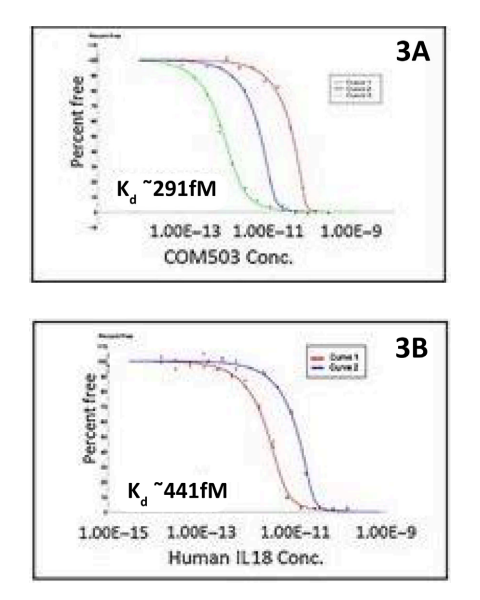
A recent 2024 publication in Cancer Immunology Research, scientists described a potent fully human antibody (COM503) that was developed to block binding of IL18BP to IL18.
A function of the IL18 cytokine is to induce inflammation in response to infectious microbes and molecules. That stimulates interferon gamma (IFNγ) production which is important for adaptive immunity.
When IFNγ is upregulated, IL18BP is induced in the tumor microenvironment (TME) and binds to IL18 in a negative feedback mechanism. Antibody COM503 was designed to block IL18BP from binding to IL18 and restore activity to endogenous IL18. The antibody proved to be a promising approach for the treatment of cancer.
KinExA was used to characterize the binding interaction of COM503 and Human IL18 to Human IL18BP. Both interactions exhibited very tight binding with Kds of 291 fM and 441 fM respectively. This study highlights the sensitivity of KinExA technology to measure precise, accurate Kd information at a level well below that of other technologies.
Frequently Asked Questions
Q : How will I know if a bubble has gone through the flow cell during sample handling?
A : You can check the “Additional Data” tab on the experiment file. An image of the flow cell before and after sample handling is captured for each run and can reveal bubbles that passed through the flow cell. You can also check the Pressure Traces for irregularity
Q : Why do I need a High Curve and a Low Curve? Why not measure one “sweet spot” curve?
A: Applying a High and Low curve to our global fit (n-curve) analysis is prudent for several reasons. It helps to identify non-standard binding events and picks out errors made during experiment preparation.
Q: Can KinExA to measure the affinity of a soluble molecule to surface proteins of intact cells?
A: Yes, KinExA can be used to measure binding affinity of a soluble molecule to surface proteins of intact cells. Click the button below and it will provide you an overview of the assay format, analysis, and considerations when performing cell based experiments.
Reducing Non-Specific Binding
Some systems exhibit high non-specific binding (NSB) values. Although NSB is an analysis fit parameter and is subtracted from the signals, noise still contributes to greater uncertainty in the measurements. If NSB is a significant percent of the total signal, it is worth some effort to reduce it before continuing.
Note: Some NSB strategies may interfere with one another so test them individually to avoid skewed results.
Identifying and Understanding the Source of NSB.
- Previous Studies: Did this system show high NSB in other experiments? For example, if an ELISA assay with this system showed high NSB, the KinExA assay may also show high NSB. Any strategies that worked for ELISA will likely help in the KinExA assay.
- Solid Phase: One of the most effective methods to reduce NSB is to change the solid phase. Tech Note 222 Solid Phase Selection Guide (TN222) shows which solid phase alternatives may be appropriate. The solid phase can have a large change in the specific signal so it is a good idea to look at the results in terms of the net signal (Signal – NSB).
- Label: The label you use may effect the NSB values. To see if the label has NSB, run a sample without CBP. If it does, try a different label. There are a variety of different labels available that are subclass specific, heavy and light specific, or cross adsorbed. We’ve had good results with labels from Jackson Labs (jacksonimmuno.com). See Tech Note 223 Labeling Strategies (TN223) for more information.
- Titrant: If the NSB is coming from the titrant, there is usually a characteristic signature of the signal increasing at the highest titrant concentrations. See Tech Note 210 Titrant Related NSB (TN210) for an example of this. If the titrant has a HIS-tag, sometimes reversing the assay and using the HIS-tagged molecule as the constant binding partner (CBP) will help. This will reduce the amount of HIS-tag in the samples. Otherwise refer to the Add imidazole section in this document.
Other NSB Strategies
- Add or Increase the Amount of Blocking Protein: Normally, 1 mg/mL of BSA is recommended but a higher concentration can be tried. Other proteins such as casein or milk sometimes work better. Commercial blocking buffers (SuperBlock, SEA BLOCK, or Protein-Free Blocking Buffer) from Life Technologies (www.lifetechnologies.com) are also available.
- Add a Detergent: Tween 20 (sigmaaldrich.com) at a concentration of 0.01% can be helpful. Detergent can be used in the samples and/or the label. If the solid phase is adsorption coated it should not be used in the bead vial as it will cause the solid phase coating to desorb. There are many other detergents available. Life Technologies’ website has some good information to help select a detergent for a particular system (search for “Detergents for Cell Lysis”).
- Increase the Salt Concentration: Most biological buffers contain salt at a concentration of 100-150 mM. In some cases it has been effective to have a higher concentration salt wash after the sample or label. More salt can also be added to the sample buffer. Caution should be used as more salt can interfere with the binding being measured, especially at concentrations over 500 mM. When testing higher salt concentrations, either in the buffer or as a wash, be sure to test the effect on signal as well as NSB.
- Add Heparin: Heparin has been used at concentrations of 50 to 500 μg/mL. In some systems it may work at even lower concentrations. The pH of the buffer should be checked after adding heparin.
- Add Imidazole: Imidazole is a functional group on histidine and can be particularly helpful for systems that have a HIS-tag. Sometimes it also helps with non-HIS tag systems that exhibit high NSB. We usually run imidazole at 10 mM concentration. The pH of the buffer should be checked after adding imidazole.
Meet Buddy!
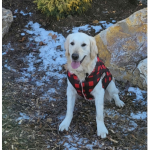 Buddy, the patriarch of our Sapidyne Instruments office dog clan, proudly holds the distinction of being our eldest four-legged team member, nearing his fifth year. With a coat of creamy white fur that radiates warmth, Buddy embodies the epitome of a gentle and playful golden retriever. His sweet demeanor and boundless energy infuse our workspace with an aura of joy and companionship. Though he occasionally leaves a trail of drool in his wake, Buddy’s penchant for seeking attention only endears him further to our hearts. In his downtime, you’ll often find him frolicking with his human siblings or bounding with enthusiasm towards the dog park. Buddy’s presence enriches our office environment, reminding us all to cherish life’s simple pleasures and to greet each day with a wagging tail and an open heart.
Idaho Science News Spotlight
Micron touts progress on large expansion to federal leaders
Micron is progressing on a $15 billion expansion of its Boise campus. The expansion will create the first new U.S. microchip fabrication plant in 20 years, generating about 4,000 construction jobs and 2,000 permanent jobs by 2026. This initiative aims to boost U.S. microchip manufacturing to address supply chain issues and strengthen national security.