
Newsletter #15

User Spotlight
Dr. Palaniswami Rathanaswami: Early Adopter of KinExA Technology
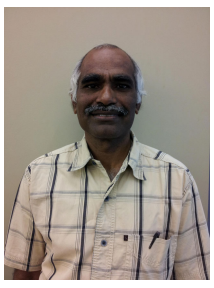 Dr. Palaniswami Rathanaswami (Swami) has been pushing boundaries and expanding the application of KinExA for over 25 years. While at Abgenix, Swami became the first to publish KinExA measurements of a femtomolar Kd antibody (1), a publication that also highlighted the reproducibility of KinExA measurements made by different people in different labs over a period of more than a year. Working at Amgen, Swami published a method using KinExA to measure cell surface epitopes that did not require a purified epitope (2), a significant advancement and instrumental in developing the Reverse Format KinExA method to measure high affinity interactions of native molecules and antigens available only in picogram quantities (3). Also, at Amgen he became the first to publish a method to screen a panel of antibodies using a rapid single inhibition test (4). This last publication also currently holds the record for the tightest published KinExA Kd antibody measurement at 34 fM.
However, his accomplishments have not been limited to KinExA technology. His extensive knowledge and experience with surface plasmon resonance (SPR) and bio-layer interferometry (BLI) technologies have further cemented his reputation as a subject matter expert in the field. Dr. Rathanaswami has authored more than 40 scientific articles and holds over 20 patents.
At Sapidyne, we are honored to have collaborated with Dr. Palaniswami Rathanaswami and look forward to continuing our partnership as he transitions to consulting for PRSwami AbDev Inc. We encourage our customers to reach out to him with any questions about therapeutic antibody discovery, development, and KinExA applications.
References
- Rathanaswami, P., S. Roalstad, L. Roskos, Q. J. Su, S. Lackie, and J. Babcook. “Demonstration of an in Vivo Generated Sub-Picomolar Affinity Fully Human Monoclonal Antibody to Interleukin-8.” Biochem Biophys Res Commun 334, no. 4 (September 9, 2005): 1004–13.
- Rathanaswami, P., J. Babcook, and M. Gallo. “High-Affinity Binding Measurements of Antibodies to Cell-Surface-Expressed Antigens.” Anal Biochem 373 (2008): 52–60.
- Rathanaswami, P., K. Richmond, K. Manchulenko, I. Foltz. Kinetic analysis of unpurified, native antigens available in very low quantities and concentration. Anal Biochem. 414 (1):7-13, 2011. PMID: 21371417
- Kielczewska, Agnieszka, Igor D’Angelo, Maria Sheena Amador, Tina Wang, Athena Sudom, Xiaoshan Min, Palaniswami Rathanaswami, Craig Pigott, and Ian N. Foltz. “Development of a Potent High-Affinity Human Therapeutic Antibody via Novel Application of Recombination Signal Sequence-Based Affinity Maturation.” Journal of Biological Chemistry 298, no. 2 (February 2022): 101533. https://doi.org/10.1016/j.jbc.2021.101533. See Supplemental Information for single point screening.
Implement A Cleaning Cycle
Various tubing is used on the KinExA 4000 to move samples through the instrument. Common lines used include:
- Teflon® tubing. This tubing has a low coefficient of friction, chemically resistant, and has a broad temperature range. This tubing is used as the sample line, on each side of the flow cell, on the pressure transducer, right side of the aspiration valve, and on the backflush isolation valve.
- Excelon ® tubing. This tubing is a clear, flexible tubing. It is used as the buffer and waste lines.
- PharMed® tubing. This tubing is used on the peristaltic pumps due to its durability.
While all the tubing is meant to resist adsorption of biological samples, adsorption can still occur. When it becomes extreme, contamination occurs which can effect subsequent experiments. To avoid contamination, Sapidyne recommends cleaning at least once a month during high use times. Refer to KinExA 4000 & Autosampler Cleaning Guide (HG201).
Additionally, a cleaning template has been added to software versions 4.5.28 and newer to allow a cleaning protocol to take place between experiments. This cleans the instrument right after samples are run to help avoid having samples sit in the sample lines thus reducing the opportunity to adsorb to the tubing walls and glass flow cell.
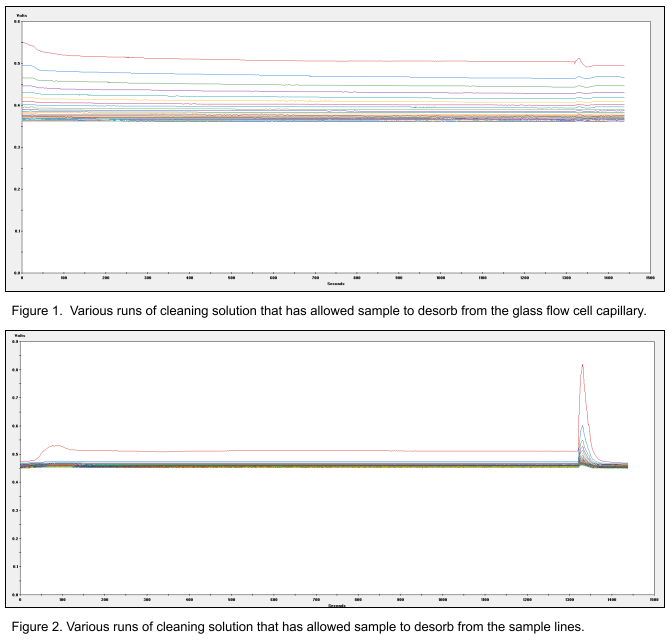
Figure 1 shows an example of a cleaning template where samples are de-sorbing from the glass flow cell wall after each run of Sapidyne Cleaning Solution (Part# 2T7010). Figure 2, shows protein de-sorbing from the sample lines. We are able to differentiate between proteins sticking to the flow cell versus the sample line because of the sample trace profile. The cleaning template brings in cleaning solution, allows the sample to sit for a period of time before being flushed out of the instrument with buffer. In Figure 1, the sample trace shows a steady decrease even during the soak time. In Figure 2 however, a large peak is seen during the final wash indicating fluorescent sample upstream from the flow cell is being washed out of the system. In both cases, allowing the soak time is beneficial for removing build up in the instrument.
Accessing the Cleaning Template:
- In KinExA Pro, select File>New>New from Template.
- Select Cleaning from the options listed.
- Select the Timing Setup tab.
- The Standard Wash Template requires you to designate where the wash solution is located on the instrument.
- By default, Standards: Tube 1 is selected under Sample Timing.
- That can be changed to any other location designated in the sampling area. NOTE: 2 mL of sample is needed for each run.
- The following buffer step designates the soak time. Normally 300 seconds is sufficient, however if the system is particularly sticky, increase this time to 1200 seconds.
- Under the Instrument tab the Number of Cycles defaults to 5 cycles, which means the minimum volume of cleaning solution is 10 mL. Increase as needed. NOTE: increase the volume of the cleaning solution to account for more cycles.
- The Standard Wash Template requires you to designate where the wash solution is located on the instrument.
- After an experiment has been queued to run, queue the cleaning template by selecting Start.
- The cleaning file will be run as soon as the experiment finishes.
- If additional experiments are needed, queue them after the cleaning template. NOTE: selecting Start for any experiment or cleaning template will place it in queue after the previously run experiment.
- We normally use Sapidyne Cleaning Solution (2T7010) however, 0.5% NaOCl (sodium hypochlorite) or 5% household bleach, can also be used. NOTE: If bleach is used, always run a cleaning with Cleaning Solution or Buffer to remove residual bleach.

Established in 1924, Craters of the Moon National Monument and Preserve is a vast volcanic landscape located in southern Idaho. It features unique lava formations, including various types of pahoehoe lava, and spans over 43,000 acres of designated wilderness. The monument is known for its rugged, moon-like terrain, which has been used by NASA for research since 1969. It also holds cultural significance for the Shoshone and Bannock peoples and is a popular destination for stargazing and hiking, offering visitors a glimpse into Idaho’s volcanic past.
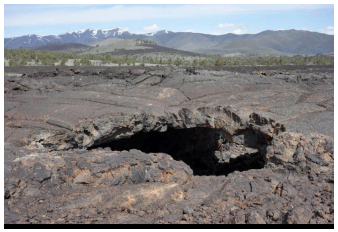
Craters of the Moon is one of the youngest volcanic areas in Idaho and may be the most likely in the state to erupt again. Over the past 15,000 years, eruptions at Craters of the Moon have occurred about every 3,000 years, and so the next eruption might be expected sometime in the next 1,000 years. Besides its fascinating geologic history, Craters of the Moon is also a unique landscape that is recognized as a National Monument.
Meet Birdy!
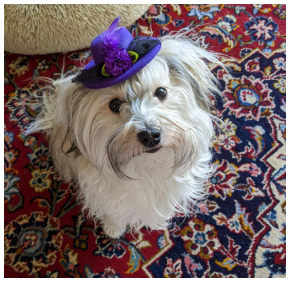
Birdy is a 2.5 year old Havanese that happens to be the smallest of the office dogs at Sapidyne but makes up for it with her big personality! She is as sweet as they come, loves touring Boise, and being close to her humans. Her favorite game is hide and seek with a special toy. She is very soft and fluffy which makes for an optimal cuddle buddy and general petting by office staff. Birdy brings joy and comfort to her family and is very much appreciated and loved.