
Technology Note 216
Baseline Creep
Baseline creep occurs when label accumulates on reagents that have stuck to the sides of the flow cell. During each run, more reagent and label sticks to the sides of the flow cell causing the baseline signal to slowly increase. This document will illustrate baseline creep and discuss how it affects experiments.
A “sticky system” is a system where one or more reagents have a high level of NSB (non-specific binding). Sometimes this NSB is to sides of the glass flow cell. Normally these reagents are flushed out of the flow cell during the buffer rinse, but with a “sticky system” the reagents are able to remain on the sides of the flow cell throughout the buffer rinse. Eventually, these reagents get labeled and cause the baseline signal on the experiment to steadily rise with each consecutive run. This “baseline creep” is illustrated by the red circle in Figure 1.

Figure 1. An example of baseline creep.
In the KinExA® Pro software, net signal is measured as final signal minus the baseline. By subtracting the baseline from the final signal, baseline creep will not have a significant affect on the individual signals, therefore there will be little impact on the measured Kd. The baseline creep will, however, broaden the 95% confidence intervals. Any time you have a system that is exhibiting unwanted levels of NSB, you can try the common buffer additives for reducing NSB:
- Tween or other detergents.
- BSA, Casein, or other proteins.
- Heparin or Imidazole.
In addition to the normal NSB strategies, a siliconized flow cell (Part #: 392150) has been shown to greatly inhibit the buildup of reagents to the walls of the flow cell. Although it may not work with every system, or completely fix every baseline creep problem, it has been quite effective in our testing, as shown in Figure 2.
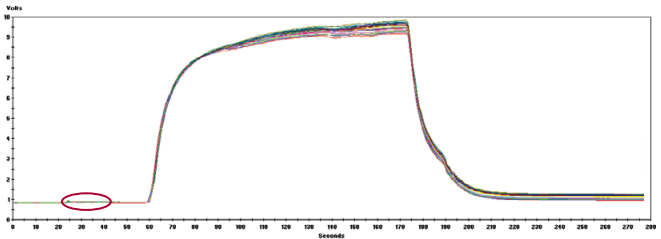
Figure 2. A “sticky system” run using a siliconized flow cell.