
Technology Note 221
KinExA Mode
In a Kinetic Exclusion Assay (KinExA®) the underlying principal is that the contact time of any portion of the sample to the solid phase is shorter than the dissociation rate of the complex. This kinetically excludes competition from occurring between the solid phase and solution phase materials. With weaker binders and faster off rates some competition may occur. This Tech Note will explain when this can happen, how you can tell, and what to do to overcome it when running KinExA experiments.
Being “in the KinExA Mode” means there is not any significant competition occurring and the signal is proportional to the free constant binding partner (CBP) in the sample. If the system is out of the KinExA Mode, the solid phase captures not only free CBP but CBP that was complexed with the titrant. Consequently a higher signal, and thus a falsely high percent free CBP will be reported. Measurements conducted under these conditions will cause the Kd to appear weaker than it actually is (Figure 1).
When running the KinExA instrument at the default flow rate (0.25 mL/min), the contact time of the sample to the solid phase is about 0.5 seconds. At this contact time systems with a single digit nanomolar or tighter Kd will generally be in the KinExA Mode. A test can easily be performed to verify no competition is occurring and the system is indeed in KinExA Mode. This test looks at a single inhibition point at different flow rates to see if the percent free changes. Since the signal will change with each flow rate, an uninhibited point (Sig 100) and a point near full inhibition (NSB) will need to be run to calculate the percent free for each flow rate. For the inhibited point select a titrant concentration that results in nearly 50% free CBP. For each flow rate calculate the percent free for the inhibited point using the following formula:
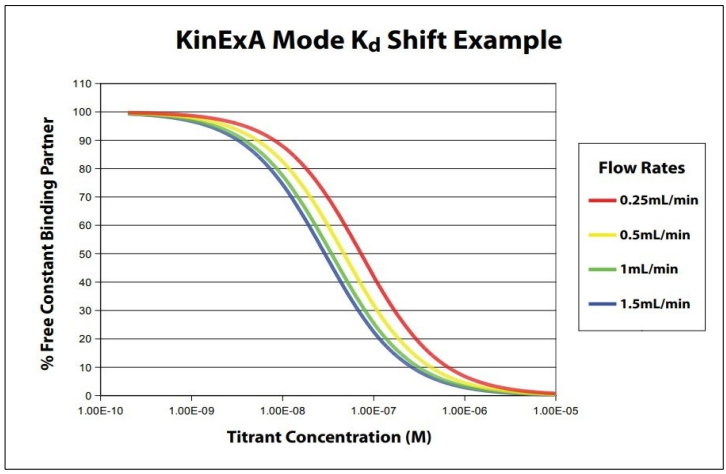
Figure 1. The best Kd is 2.2 times tighter at 1.5 mL/min when compared to 0.25 mL/min.
To illustrate the KinExA Mode test an experiment was conducted to compare a weak and a tight system (Figure 2). The system that was weak also had fast kinetics, which are the two factors contributing to the possibility of being out of the KinExA Mode. As a result the percent free CBP for the weak, fast system decreases as the flow rate increases until around 1.5 mL per minute. For this system a Kd experiment would need to be run at 1.5 mL per minute or higher to be in the KinExA Mode. This is not an issue for tighter systems, as shown by the blue line in Figure 2. Increasing the flow rate did not result in a shift in the percent free.
The tight system was run at the same 5 flow rates as the weak system. This was done to illustrate the percent free at various flow rates, but only 2 flow rates are needed to verify that you are in the KinExA Mode. Users may consider conducting a KinExA Mode test if preliminary range find results indicate a Kd weaker than single digit nanomolar.
Note: When running the KinExA with soft beads at faster flow rates include 15 seconds of no flow at the beginning and 60 seconds at the end of the wash step. This allows the soft beads to expand to their normal volume (flow compresses them) before the signal is calculated.
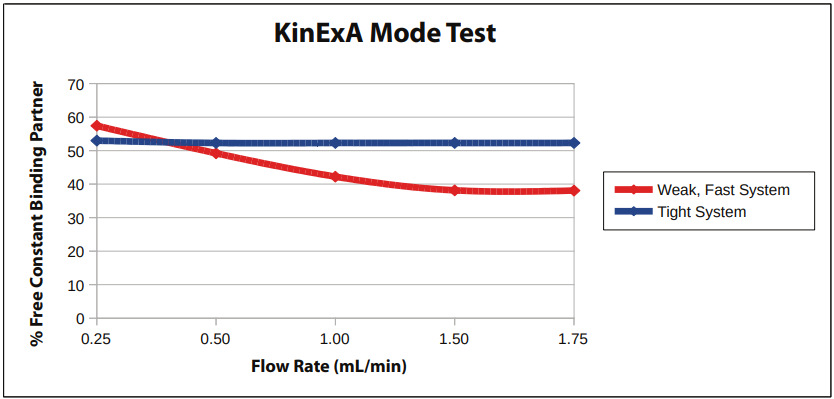
Figure 2. Example of a tight binding system in KinExA Mode at the default flow rate and a weak binding system not in KinExA Mode until about a 1.5 mL/min flow rate.