
Newsletter #9

Temperature Effects on Kd Measurements
As a general rule of thumb, the Kd becomes tighter and kinetic values will decrease as temperature decreases. We are aware of only a few cases where this rule is violated. For the most accurate data, binding measurements should be made under conditions as close to their intended application as possible. It is our opinion that, in pharmaceutical development, affinity and kinetic measurements should be made at 37°C since this is the temperature at which the final therapeutic will be delivered.
In keeping pace with the latest trends in physiologically relevant data measurements, we’re pleased to announce a temperature controlled chamber designed to accommodate any KinExA instrument, the TC1000.
With the TC1000 you can easily incubate samples and run experiments at any temperature between 4°C and 40°C. Temperature is automatically recorded for each sample run and interior cameras allow viewing inside the chamber without perturbing the inside environment. The wide range of temperatures allows estimation of the thermodynamic parameters of binding (change in enthalpy ΔH, change in entropy ΔS, and change in heat capacity ΔCp).
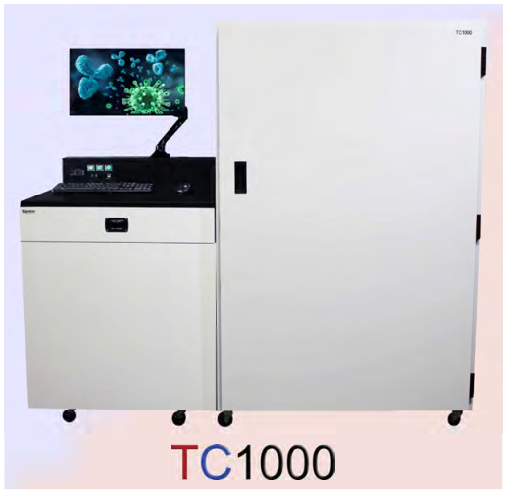
Additional features include:
- An integrated Windows 10 computer and monitor installed with KinExA Pro Software.
- Custom-made lab bench that is acid and chemical resistant and doubles as a convenient workstation.
- Level Sensors that monitor the buffer and waste levels.
- Replaceable air filters protect the evaporator and condenser coils from dirt and dust, maintaining high efficiency and reducing service needs.
- A tough steel interior and careful attention to design details ensure your unit will last and maintain a safe environment for the instrument and samples.
- Temperature uniformity allows for exact temperature control, providing more confidence in analysis results.
- Includes a one year warranty.
Sapidyne is accepting pre-orders for a 10% discount until January 31, 2021. The units will be available first quarter of 2021.
Contract KinExA Research
The unprecedented effects of COVID-19 are leaving many researchers tasked with catching up on a heavy workload and Sapidyne is here to help. Our contract research team is available to perform lead characterization (including cell based work) or third party verification for projects moving forward to an IND submission, FDA approval, or clinical trial. Services can be requested via our website, scientist.com, or scienceexchange.com.
Literature Spotlight: Capture Surface & SPR
In a recent study, scientists at Regeneron describe how SPR capture surfaces can profoundly impact the binding kinetics that are measured for molecular interactions. In the study, [6] different human monoclonal antibodies were measured using [8] different molecules on the capture surface. Binding constants measured using SPR were shown to be strongly influenced by the choice of capture molecule and consistently weaker than those measured in solution using KinExA. Depending on the immobilization molecule, SPR based Kd values were from 3 to 2826 times weaker than those measured using KinExA.
Kamat, Vishal, et al. “The impact of different human IgG capture molecules on the kinetics analysis of antibody-antigen interaction.” Analytical Biochemistry, 10 Jan. 2020. DOI: 10.1016/j.ab.2020.113580
Geek Corner
Software Shortcuts
On the timing setup page in the Draw Source column you may enter or change your sample set using commas to specify non contiguous sample lines or a dash to enter contiguous sample lines. Time, Volume, and Rate of the sample set header row will be copied down to all lines of the sample set. Below are examples for the KinExA 3000, 3200, 4000, and Autosampler sample sets.
Note: The Autosampler works the same as the 3000/3200 except the rack number must be specified. The first digit of a 3 digit number specifies the rack number, and the last two digits designate the tube number in the rack. For example, a tube in the 38th position on the 3rd rack would be 338.
Concentrations may be entered in a similar fashion into the Concentration column of either the Timing Setup page or the Binding Signals page. You may not mix arithmetic operators (*, /, +, −) within a single dilution string. However you may enter a dilution string on any row of the concentration column. The ^ symbol reverses the order of the dilution string. The number to the left of the arithmetic operation is always assumed to be concentration. If no units are given then nM is applied.
96 Well Microtiter Plate
Designating sample well locations for a 96 well microtiter plate can be sampled across the plate or down as seen in Table 1. If sampling down the plate, designate the rack number, incorporate a colon, and then the wells the samples will span (e.g. 3:A1–B4). The sample selection moves down, then right to left, starting at the top right corner. If sampling across the plate, designate samples similar to a normal rack. Make sure the dual microtiter plate rack is being used.
For a more comprehensive description and additional shortcuts, refer to Tech Note 209 Software Shortcuts.

Tips & Tricks
Aluminum Tape
One of the benefits of using a 4000 or Autosampler is the ability to queue up multiple experiments. Sometimes these experiments run over a long period of unattended operation (i.e. overnight or through the weekend). This autonomous operation time introduces a potential for evaporation if samples are left uncovered. To remedy these effects, we use aluminum adhesive tape to cover our samples.
The sampling arm on the instruments have no trouble piercing through the tape and it is a better alternative to X-Pierce film, labeling tape, or Parafilm. These alternatives are more costly, temperature sensitive, and cause residue to buildup on the sampling arm or cause z-axis crashes.
When applying tape, cover the entire sample set and make sure it has contact with the rack. This will ensure the samples stay in the rack once the sipper tip pulls away from each tube.
When using large volumes with long run times samples can be prepared, split into two sets, and covered to avoid long term exposure during duplicate runs. The sample will then only be exposed when being drawn through the system. This method can also be advantageous for small volumes on a microtiter plate rack as well as 37°C measurements.
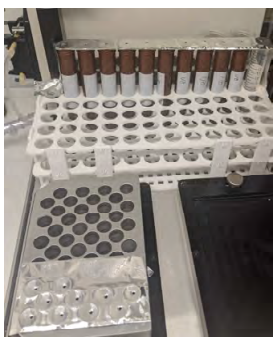
Tape can be purchased in a variety of different sizes. We like JVCC AF20 Aluminum Foil Tape the best.
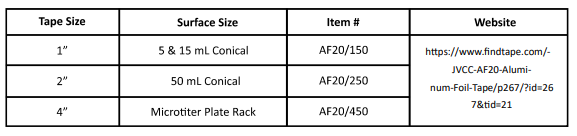
Tape can be sourced at findtape.com.
25th Anniversary

2020 has been a journey. Thank you for all of your hard work and dedication during this difficult year. We would have liked to have a party to celebrate 25 years however COVID had other plans. In lieu of a get together, we would like to send you an Idaho made gift so you can celebrate with us from your home or office. Just send an email with your shipping address to info@sapidyne.com.
© 2020 Sapidyne Instruments Inc.