
Newsletter #10

Cell Pellets & the Effects on Equilibrium
KinExA affinity measurements for a specific binding target to cell expressed receptors require the reaction to be at equilibrium. After cells equilibrate with the target, they are pelleted and the supernatant is retained for subsequent experiments (Figure 1).
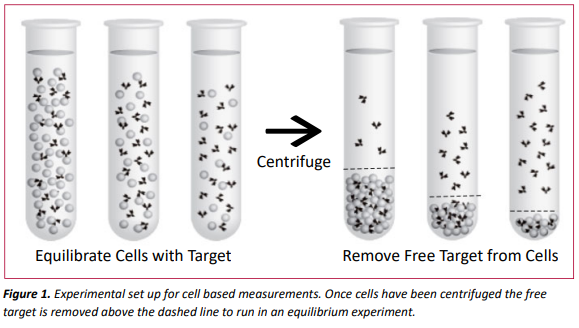
During the centrifugation process, which takes a few minutes, the cells become concentrated into a pellet at the bottom of the sample tube. This process will not effect the equilibrium of the samples and can be demonstrated by following the equations.
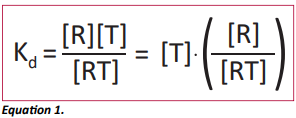
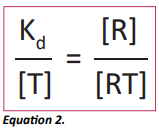
When the cells are pelleted, their concentration is increased in a local area, but the free target concentration did not change. Since both the bound and unbound cell concentrations are increased by the same amount in the pellet, the ratio [R]/[RT] stays the same. Looking again at Equation 2, you can see that although the local concentration of the cells changed, the overall equation does not. Therefore, during the pelleting process, you can be sure the equilibrium does not shift.
In fact, after the cells are pelleted, you can remove the supernatant and the equilibrium is still not affected. Although you did remove some of the volume, you did not change the free target concentration therefore everything in Equation 2 remains the same.
Kinetic Exclusion Assay (KinExA) Now On Wikipedia: en.wikipedia.org/wiki/Kinetic_exclusion_assay
Advanced Flow Cells for Sticky Systems
 At Sapidyne, our R&D team is continuously working to improve our measurement capabilities and overcome the issues that interfere with getting consistent, clean data. One of these issues is measuring “sticky” systems that cause baseline creep and titrant related non-specific binding. See Tech Note TN216 Baseline Creep and Tech Note TN210 Titrant Related NSB for more information. In our 2013 Newsletter we introduced our siliconized Flow Cells to help fight these sticky systems. We now have a new, improved, flow cell that does the job better.
The inner surface of the new flow cell has been chemically modified by attaching a PEG-Silane molecule. This makes a hydrophilic surface thereby reducing the ability of proteins to stick. We tested a particularly sticky system of antibodies extracted from chicken yolks that were run through the Hydrophilic Flow Cell. The Hydrophilic Flow cell resulted in only 0.30 V of baseline creep after 10 runs compared to the 0.77 V increase observed in the Siliconized Flow Cell.
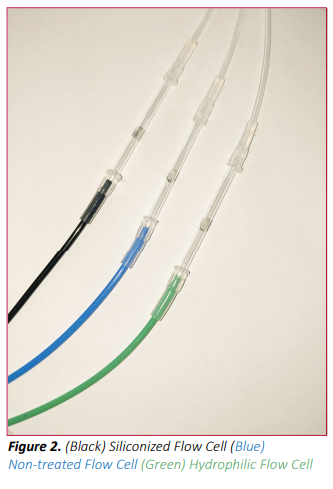
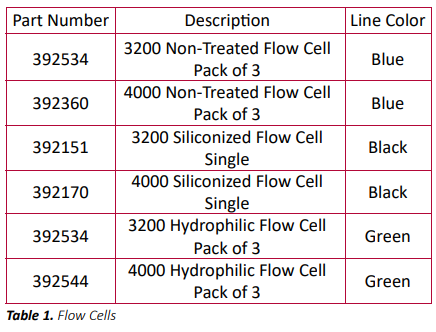
Available Flow Cells can be seen in Figure 2 and differentiated by exit line color. See Table 1 for more information and contact Sapidyne for ordering information.
Flow Cell options: Non-Treated (Blue line) – Part #392534 (3200) / #392360 (4000), Pack of 3. Siliconized (Black line) – Part #392151 (3200) / #392170 (4000), Single. Hydrophilic (Green line) – Part #392534 (3200) / #392544 (4000), Pack of 3.
LED Lamp Replacement – KinExA 3200
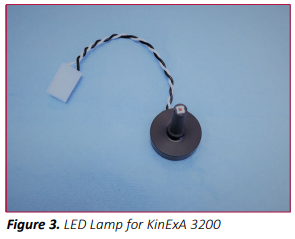
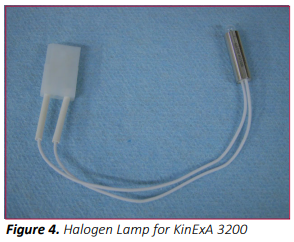
We are now offering an LED lamp replacement with a much longer life span and a 10 year warranty (Figure 3). The LED lamp is a direct replacement for the halogen lamp (Figure 4).
Advantages to using the LED lamp are: fewer lamp replacements, lower baseline signal, and low risk of lamp burnout while an experiment is running. LED lamps also use 10% of the electricity that halogen lamps use.
Replacing your old lamp with the new LED lamp is straight forward and can be completed in 5 minutes with 3 easy steps:
- Turn the old lamp off and remove it from the instrument.
- Plug in the new LED lamp and turn it on.
- Adjust the new LED lamp to ensure proper focus and alignment.
An in-depth How to Guide can be found on our website under the resources tab titled HG204 Lamp Replacement and Alignment, which walks you through the alignment process in detail with helpful pictures to guide you. There are specific LED lamps depending on the filter set being used. Refer to Table 2 for LED lamp specifications.
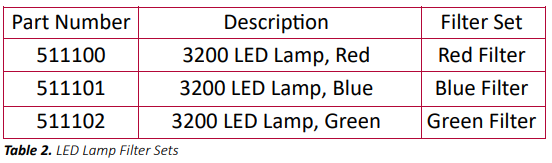
LED Lamp options: 3200 LED Lamp, Red (Part #511100) – Red Filter. 3200 LED Lamp, Blue (Part #511101) – Blue Filter. 3200 LED Lamp, Green (Part #511102) – Green Filter.
Ask the Inventor
Question
What is the difference between avidity and cooperativity?
 Answer
I’ll start with two definitions.
Cooperativity: (noun) specifically, biochemistry: the molecular interaction between a ligand and macromolecule (e.g. protein) having two or more binding sites in which binding of a ligand to one site positively or negatively influences subsequent ligand binding at other sites by either increasing or decreasing the affinity of other binding sites for a ligand.
Avidity: (noun) In proteins, avidity describes the binding intensity of multiple bond interactions between proteins.
The difference is in the biochemistry definition. Cooperativity refers to a change in a binding site’s affinity caused by binding at an alternative binding site on the same molecule. The molecule exhibiting cooperativity must be multivalent but the ligand causing the change does not. Avidity, on the other hand, does not include a change in binding site affinity but refers instead to the tighter binding that can result from multiple simultaneous binding events between two multivalent molecules.
I believe the confusion arises because cooperativity suggests cooperation (the process of working together to the same end) and in avidity the binding sites do work together to produce a stronger overall binding. Biochemically speaking, the difference is significant. Cooperativity changes the shape of the binding curve making it steeper than normal 1:1 binding and avidity does not. A well known example of cooperativity is with hemoglobin and oxygen. The steeper cooperative curve significantly increases hemoglobin’s oxygen transporting efficiency and is also important in signaling cascades.1 Please see Technology Note TN213 Cooperativity for more information.
- Ferrell, J.E., Jr. (2009). “Q&A: Cooperativity.” J Biol 8(6): 53.
Geek Corner
 21 CFR Part 11 Compliance
Data integrity and safety for electronic records is important for FDA submissions, patent applications, and scientific publications. In the early 1990’s, computerized systems were increasingly being used in place of paper records and signatures. Because of this, the scientific community wanted guidelines for proper electronic records and signatures. In 1997, the 21 CFR Part 11 Final Rule went into effect.1 There have been revisions and clarifications over the years but the main theme still exists; Data must be trustworthy and accurate.
The benefits to Part 11 compliance are as follows:2
- Protection and retrieval of electronic records
- Operational consistency
- Improved productivity and efficiency through automation
- Minimized or eliminated management of paper documentation
- Faster data-related searches
- Electronic submission to the FDA
All KinExA instruments are compliant with 21 CFR Part 11. The instruments are a passive system that create an unalterable read-only copy of every experiment that is run. If you look in the upper left hand corner on the “Experiment” tab of any experiment that was run, there is an ID number. During management review and internal or external audits, any experiment can be verified by checking the unalterable backup copy on the instrument.
Refer to Part 11, Electronic Records; Electronic Signatures – Scope and Application for guidance when keeping electronic records. If paper records are kept, then Part 11 would not apply.
KinExA Training Videos, How To Guides, & More: www.sapidyne.com/resources
Unlimited Scientific & Software Support: support@sapidyne.com or 208.345.3400
Employee Spotlight
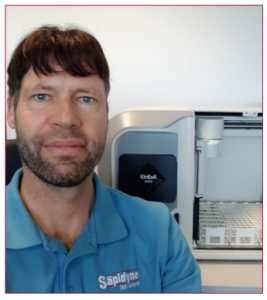 At Sapidyne we are proud to work with a highly qualified and experienced team to further develop our KinExA instruments and to serve the scientific community. The tradition of our company is to build relationships with our customers in order to give them the best possible assistance for their projects. Therefore, we are including an additional section in our Newsletter to introduce our employees more personally by showcasing their background and experience.
In this Newsletter edition, we introduce Frank Hamacher who started his work for the European branch of Sapidyne Instruments in 2014. He was born in Western Germany and studied human medicine in Hannover before completing his diploma in biochemistry at the Freie Universität in Berlin. His main focus was immunobiology and, after finishing his diploma thesis, he worked for the Institute of Pathology at the Charité Hospital in Berlin. His research at the Institute was on signal transduction pathways in cancer. Several years later he began working for the Laboratory of Immunological and Molecular Cancer Research, a division of the Oncology Department of Landesklinikum in Salzburg, Austria. There he helped to build and establish the Gene Expression Facility within the department. His research was focused on finding new drugs and biomarkers for blood cell, breast, and pancreatic cancers. During his tenure he published numerous scientific papers, gave talks at international cancer conferences, and received several awards.
In 2014, Frank ventured to the private sector by starting his work for Sapidyne Instruments. He helped to build and establish the European branch of Sapidyne in Germany to better serve those customers directly. Frank performs contract research measurements, service visits, demonstrations, trainings, and supplies consumable/part shipments. Additionally he is always ready to give instant support for any open questions regarding the KinExA technology. His goal is to make KinExA Technology more popular in Europe and to convey the excellence of the technology to our potential users.
Frank’s hobbies include traveling, cycling, tennis, and anything that promotes a happy, healthy, lifestyle.
Cleaner Water with KinExA
Evaluation of a rapid biosensor tool for measuring PAH availability in petroleum-impacted sediment
Highlights
- Freely dissolved PAHs (Cfree) in sediment correlates with bioavailability.
- A rapid and field-deployable biosensor Cfree measurement tool was evaluated.
- Biosensor results for test sediments correlated with passive sampler Cfree results.
- The biosensor is a promising screening tool to optimize future investigations.
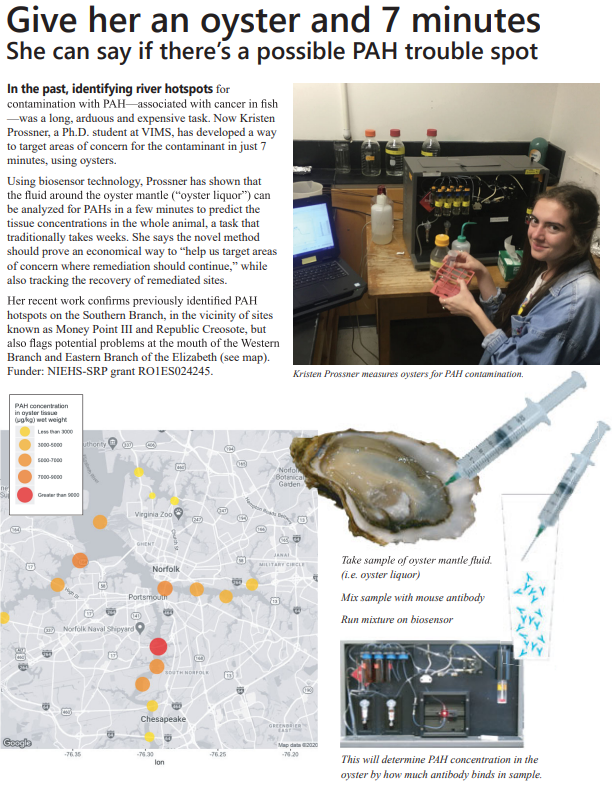
The samples were analyzed with a KinExA Inline instrument (Sapidyne Instruments, Boise ID) to determine the ΣPAH using the antibody-based biosensor method. The biosensor offers flexible field- or laboratory-based rapid assessment capabilities for generating real-time data that can be used to prioritize sediment for additional evaluations such as Cfree determination with passive samplers, toxicological testing, or other ecological evaluations. These capabilities are particularly attractive for evaluating sediments in remote locations and during a variety of investigation and remediation monitoring phases of typical sediment sites.
The KinExA Inline biosensor is pictured on page 15 of the State of the Elizabeth River Scorecard 2020. The KinExA Inline biosensor has been deployed to aid in remediation and recovery efforts in the Elizabeth River, coastal Virginia, and Galveston Bay.

Jason Conder, Mehregan Jalalizadeh, Hong Luo, Amanda Bass, Steven Sande, Michael Healey, Michael A. Unger, 2021. Evaluation of a rapid biosensor tool for measuring PAH availability in petroleum-impacted sediment. Environmental Advances 10.1016/j.envadv.2021.100032. https://www.sciencedirect.com/science/article/pii/S266676572100003X