Newsletter #17

Publication Spotlight
Investigations of Influence of Antibody Binding Kinetics on Tumor Distribution and Anti-Tumor Efficacy
Researchers at the University of Buffalo exploit KinExA’s whole cell capability, measuring both Kd and kon, to characterize solid tumor penetration and present an unexpected finding: high affinity is compatible with high penetration provided the on-rate is slow. As they note, this combination necessarily also has a very slow offrate. The authors develop a theoretical framework and show agreement with key selected measurements. KinExA was chosen for this work because
“… KinExA stands out for its applicability in quantifying high-affinity interactions. It works by measuring the concentration of free (i.e., unbound) ligand in a binding reaction that has reached equilibrium prior to the instrument analysis, effectively bypassing potential artifacts resulting from non-equilibrium conditions, ligand depletion, and mass transport effects. Such artifacts may lead to significant errors in other assays like ELISA or SPR. Additionally, KinExA facilitates the direct measurement of binding kinetics on antigen-expressing cells, reflecting real and actual binding conditions.”
FULL ARTICLE
Drug Discovery 2025
A Festival of Life Science — Visit us at Booth F18. October 21-22, 2025, Liverpool, UK.
Streptavidin Coated Beads
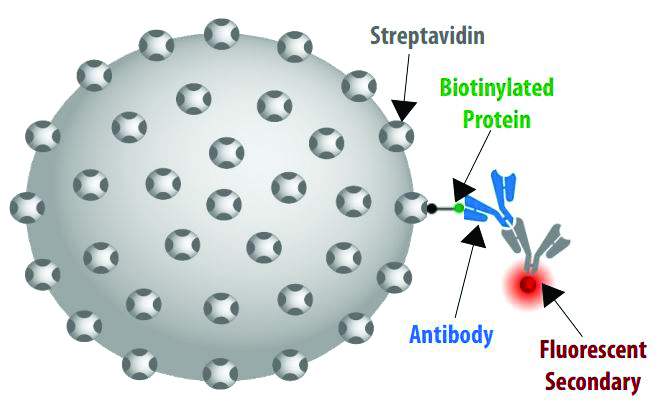
For biotinylated molecules, covalently coupled Streptavidin Glass Beads are available as a solid phase for KinExA® experiments. Streptavidin Glass Beads can be functionally coated at a much lower concentration (down to 5 µg/mL) which can be helpful when material costs are high. The length of the linker arm provides more space, allowing the biotinylated molecule to interact with and capture the solution molecules more freely (Figure 1). For cases where a biotinylated form of your molecule is not readily available, easy to use Biotinylation Kits can be ordered from Life Technologies’ website targeting a number of different reactive groups (search “Avidin-Biotin Handbook”).
With glass streptavidin beads there is no need to remove the supernatant or block the beads, as that has already been done for you. This makes coating the solid phase easy, fast and efficient. If you would like to coat your hard beads with streptavidin yourself, see How-To-Guide “Biotinylated Coating” (HG208).
In general, for Streptavidin Beads, the optimal concentration of the selected molecule is 10-30 µg/mL. However, small molecules may only need to be at a concentration of 5-10 µg/mL. These concentrations of coating material are suggested as a good compromise between signal and material. Coating with more material will not significantly increase the signal, however, coating with less will decrease the signal and the linear range of usable signals. For more information on linear range, see pages 3 and 4 or view our Technology Note “Linear Range” (TN224).
Coating Procedure
- Remove the beads from the freezer and allow the Streptavidin Beads to warm to room temperature.
- Prepare 1 mL of 5-30 µg/mL biotinylated molecule in 1x PBS, pH 7.4, 0.02% NaN3 with 10 mg/mL BSA.
- Aliquot the biotinylated molecule coating solution into the vial containing the Streptavidin-Coated Beads. Ensure that the beads are suspended in the coating solution.
- Rotate Beads for 30 minutes at room temperature or overnight at 4°C. Sapidyne recommends using a Tube Rotator (840751).
Linear Range
KinExA® Pro analysis operates under the assumption that signal is directly proportional to the free concentration of constant binding partner (CBP) in a sample. In actuality, the response is hyperbolic, but there is a range of CBP concentrations over which a linear assumption does not introduce significant error into measured Kd values. Here we describe how to define a workable linear range and how much error to expect for experiments conducted both inside and outside the defined range.
Every KinExA experiment in which the CBP is varied in the absence of titrant can be fit by a hyperbolic equation of the form shown in Equation 1.

Plotting Equation 1 using example values of A = 20V, B = 5 nM, and NSB = 0V gives the curved line shown in Figure 1. The curved line in Figure 1 represents the actual binding behavior, where the solid phase eventually becomes saturated with bound CBP and can no longer bind additional molecules. In the inset of Figure 1 the green and black arrows indicate potential “linear” concentration ranges of B/5 (20%) and B/10 (10%) respectively.

Visually, it seems unlikely that using either proposed linear range as an approximation for the blue hyperbolic response would result in a significant Kd error but we wanted a quantitative estimate of the actual error in Kd that would result.
To estimate the error in Kd, signals were simulated using the hyperbolic equation and analyzed using the standard KinExA Pro analysis with its built in linear assumption. The simulations (each conducted as a dual curve) were repeated with the CBP concentration of the simulated data representing different fractions of B. Results of the simulation are shown in Figure 2. The error bars indicate 95% confidence intervals (CI) and show that the true Kd (4 pM) is still included in the reported CI even at a CBP of 0.5*B.
Sapidyne personnel have used and promoted a rule of thumb of limiting the experiment maximum signal to 2 volts to keep in the linear range when using the red filter set. This guidance remains generally applicable but exceptions can occur. If you have unexpectedly low signals, or any other reason to be suspicious, a linearity check is quick and easy to perform.
How to determine the linear binding range
If the linear binding range is unknown, a quick, 5 point, signal test can measure the usable linear range (use the concentration immunoassay experiment type when analyzing). Starting with the concentration you would like to use, prepare a sample 4x more concentrated and serially dilute by two fold for [4] total CBP samples plus [1] NSB sample. Once the hyperbolic curvature has been defined, experiments can be prepared that keep CBP concentrations within 20% for B. If the linear binding range is relatively small, this could be due to a poor solid phase capacity or extremely high capture percentage. To overcome these issues a different type of solid phase may allow an increased capacity while a faster flow rate can reduce the capture percentage. If an experiment must be conducted with concentrations outside of the linear binding range the error can be corrected by submitting the sanitized .kxp file along with the hyperbolic signal test to a Sapidyne representative.

Join Us
Antibody Engineering & Therapeutics — December 14-17, 2025, San Diego. The #1 Antibody & Protein Conference: Your Path to Commercial Success.
Touring Idaho: Hiawatha Bike Trail

The Route of the Hiawatha, a 15-mile rail-to-trail in the Bitterroot Mountains, is a “Rail-Trail Hall of Fame” trail, celebrated for its scenic beauty and historical significance. Featuring 10 train tunnels (nine for biking) and seven sky-high trestles, the trail’s highlight is the 1.661-mile St. Paul Pass (Taft) Tunnel, connecting Idaho and Montana. With a gentle 1.6% downhill grade from 4,160 ft at Roland to 3,175 ft at Pearson, it’s family-friendly for hikers and bikers of all ages. Trail passes, bike rentals, and shuttle services are available at Lookout Pass Ski Area (Exit 0, I-90, Idaho-Montana line), with the trailhead a short drive to Taft, MT, and up Forest Service Road 506 to the East Portal.

The trail, part of the former Milwaukee Railroad, opened its Idaho section in 1998 and the Taft Tunnel in 2001, with motorized vehicles prohibited in the tunnel and Moss Creek to Pearson section. Most visitors park at the East Portal in Montana to ride through the tunnel, or at Roland to bypass it, with shuttles transporting riders and bikes back from Pearson. Notable features include an interpretive sign in the tunnel marking the state line and a waterfall at the West Portal. Historic Wallace, Idaho, 12 miles west, offers lodging, dining, and a lively bar scene.
LEARN MORE ABOUT THE TRAIL
Sapidyne Office Dogs: Sophie
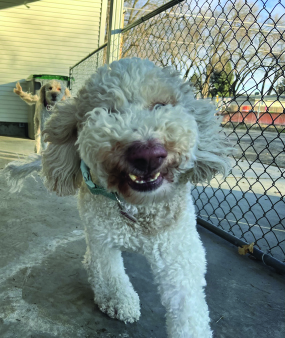
Sophie is a fun-loving doodle who fills our workspace with quiet comfort. Her fluffy curls and gentle demeanor make her a calming presence. Loyal to the core, Sophie prefers to lounge peacefully, offering a soft, reassuring nudge rather than boisterous greetings. Her tranquil energy soothes the office, transforming busy days into moments of calm and connection, making her an invaluable part of our team.