Newsletter #7

Expanding KinExA® Capabilities
At Sapidyne we pride ourselves on going the extra mile to support our customers. Support includes answering questions about software or sample prep, studying data to troubleshoot problems, offering suggestions to get better results, and developing new methods to meet your critical measurement needs. We strongly believe that the work we do with our customers not only benefits them and ourselves, but the biophysical analysis community as a whole. If you have received help from us, know that we are sincere when we say we’re glad to do it. If you have not received help from us don’t hesitate; we are available by email or phone.
Here are some examples of new measurement methods developed through customer support:
Whole Cell Measurements 1,2,3
This capability began as a customer request and continues to be refined through contract work and feedback from our customers.
Direct Off Rate Measurement 4
KinExA usually measures the equilibrium Kd and on rate directly to calculate the off rate. This methodology has worked well for Kd values down to a few hundred femtomolar. However, we developed our direct off rate measurement protocol in response to customer needs to measure tighter binders for both soluble and whole cell systems.
Competitive Binding Analysis 5
We developed a custom analysis model to allow characterization of the competitive equilibria between serum albumin and an antibody that recognizes serum lipids.
Positive Cooperative Analysis 6
This method came from our analysis of customer data that did not fit a standard 1:1 model.
These are just four examples that have led to publication but there are plenty more. Contact us if you have data that is difficult to understand or challenging measurement requirements, we would like to help.
References
-
-
- Xie, L., R. Mark Jones, et al. (2005). “Measurement of the functional affinity constant of a monoclonal antibody for cell surface receptors using kinetic exclusion fluorescence immunoassay.” J Immunol Methods 304(1–2): 1–14.
- TechNote 211 Sapidyne Instruments Inc.
- Rathanaswami, P., J. Babcook, et al. (2008). “High-affinity binding measurements of antibodies to cell-surface-expressed antigens.” Anal Biochem 373: 52–60.
- Kovalchin, J. et al. (2018) “Preclinical Development of EBI-005: An IL-1 Receptor-1 Inhibitor for the Topical Ocular Treatment of Ocular Surface Inflammatory Diseases.” Eye Contact Lens. 44(3): 170–181.
- Fleming, J. K., T. R. Glass, et al. (2016). “A novel approach for measuring sphingosine-1-phosphate and lysophosphatidic acid binding to carrier proteins using monoclonal antibodies and the Kinetic Exclusion Assay.” J Lipid Res 57(9): 1737–47.
- Blake, R. C., 2nd, J. B. Delehanty, et al. (2003). “Allosteric binding properties of a monoclonal antibody and its Fab fragment.” Biochemistry 42(2): 497–508.
-
Tips & Tricks
Bead Coating
Efficient bead coating plays an important role in generating good signal with the KinExA instruments. One type of bead we recommend is the UltraLink Biosupport Azlactone beads, from Thermo Scientific (Cat# 53110), which allow for the covalent coupling of proteins with primary amines. Sapidyne also sells these beads (Part# 444110) in premeasured amounts.
In our quest for continued optimization, we decided to try Thermo Scientific’s suggestion of adding a lyotropic salt, sodium citrate, to our buffer coating solution. The addition of a lyotropic salt increases the coupling efficiency by driving the protein molecules toward the bead surface.1
We tested different coupling solutions to see how coating was affected. Following our standard coating procedure, 20 μg/mL of Insulin was added to the desired coating buffer and rotated with 50 mg of Azlactone beads for 2 hours at room temperature. After coating, the supernatant was removed and each vial of beads was blocked with 1 M Tris Buffer, pH 8.6 + 10 mg/mL BSA for 1 hour at room temperature. In the experiments, an anti-insulin and NSB sample were passed over the beads and the net signal was calculated by subtracting the NSB signal from the anti-insulin signal (Table 1).
The results in Table 1 indicate 50 mM Carbonate Buffer produced better signals than a higher concentration of Carbonate Buffer. The signal further increased by 14% when Sodium Citrate was added to 50 mM Carbonate Buffer. This modified coating procedure is detailed in How To Guide 209 Azlactone Coating (HG209). Buffer Pre-Mix for both coating (Part # 2S6320) and blocking (Part # 270205) are available from Sapidyne Instruments.

Reference Spotlight
Three for the Price of One
KinExA technology has been used to measure the apparent affinity for a combination of [3] antibodies against botulinum neurotoxin (BoNT).1 The combination resulted in much tighter apparent affinity than one antibody alone and greater neutralization of the BoNT. Recently, researchers from the University of California, San Francisco have successfully designed, produced, and tested a single tri-epitopic IgG1-based monoclonal antibody that retains similar potency as the [3] individual antibodies.2 Site binding Kd’s for individual epitopes were investigated and compared to the whole IgG using KinExA. The role of the avidity in binding is also being discussed.
- Nowakowski, A, et.al. (2002). Potent neutralization of botulinum neurotoxin by recombinant oligoclonal antibody. Proc. Natl. Acad. Sci.USA, 99, 11346–11350.
- Lou, Jianlong, et al. (2018). A single tri-epitopic antibody virtually recapitulated the potency of a combination of monoclonal antibodies in neutralization of botulinum neurotoxin serotype A. Toxins 10(2), 84. http://doi.org/10.3390/toxins10020084.
Ask the Inventor
Question
The dielectric grease for the flow cell is messy and interferes with my camera images, do I really have to use it?
Answer
Yes, if you want the best signals. The dielectric grease is a refractive index matching compound. If you place the flow cell into the grooved lens without the grease there will be two glass-air interfaces with a very small air gap between. Light is lost to reflection whenever it crosses from one refractive index to another and the job of index matching compounds is to reduce or eliminate this loss. Even more significant, the groove in the grooved lens is made by abrasive grinding (think sandpaper) which results in a series of small scratches on the surface. These scratches scatter light and cause additional signal loss unless they are filled in with index matching grease. The bottom line is, if you don’t apply the grease you’ll lose 20 to 40% of your signal. For a specific example, I prepared a large batch of reagent and compared signals with and without the dielectric grease. Dielectric grease increased the binding signal from an average of 1.31 volts to 1.92 volts, about a 46% increase.
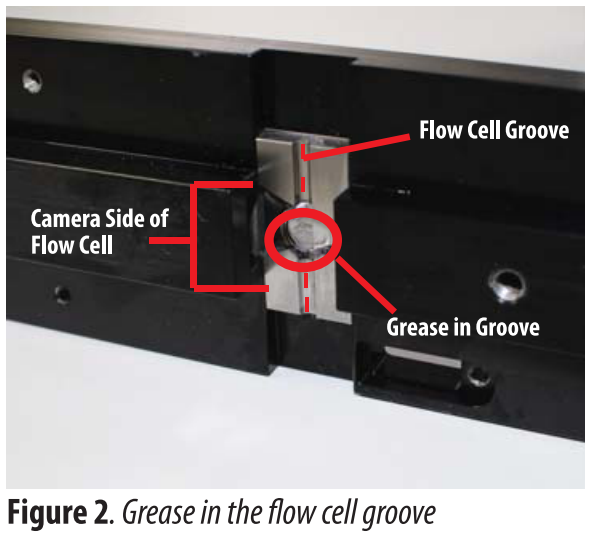
However, excess grease can degrade the flow cell images, as seen in Figure 1. When installing a new flow cell we recommend applying a small amount of dielectric grease in the center of the grooved lens. Figure 2 shows a closeup of an appropriate amount of grease, shown inside of the red oval. This was applied as a small dot but spread out in the groove. A small amount of grease should also be applied to the center of the reflector groove.
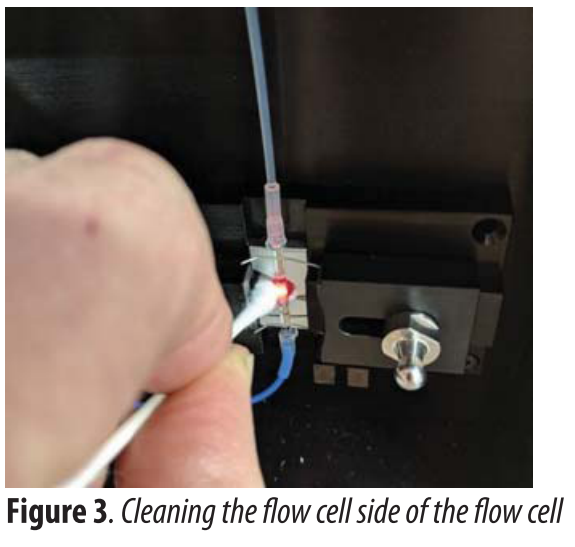
When a flow cell is pressed into the groove some of the grease may be pushed out on the camera side of the flow cell. You can use a cotton swab or kimwipe to clean the excess grease and the image should clear up (Figure 3).
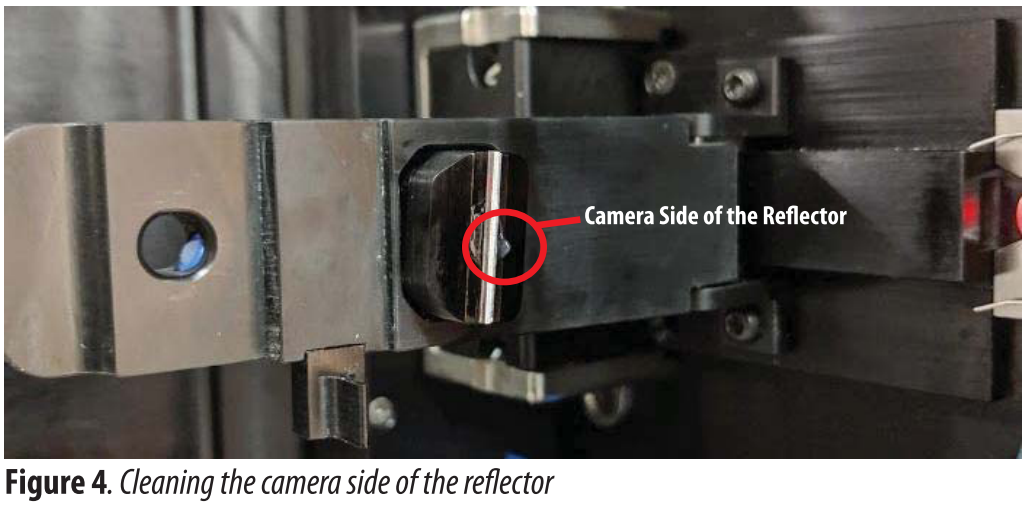
A similar effect on the reflector can lead to excess grease as well. Although you can see grease on both sides of the reflector, only grease on the side closest to the reflector arm hinge (shown circled in Figure 4) interferes with the camera image and needs to be removed. When wiping the excess grease from the reflector be careful not to remove it from the reflective groove itself.
Overall, I strongly recommend cleaning your grooved lens and applying fresh grease every time you change the flow cell to ensure the best signals and crisp flow cell images.

New Features (Geek Corner)
With the release of the new KinExA 4000 instrument, customers now have access to additional software features that are not available with the legacy models.
Temperature Tracking
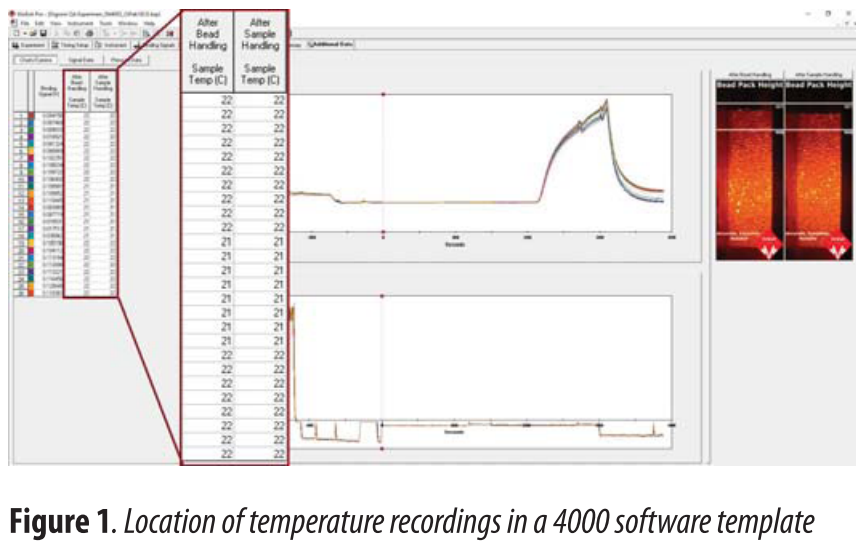
Under the Additional Data > Charts tab, the temperature is recorded twice for each run throughout the experiment: once after the beads have been loaded into the flow cell and again after sample handling (Figure 1). This feature gives our users confidence that their samples maintained the correct temperature stasis, producing the most accurate Kd value.

EverExcite System
In some cases, it can be challenging to work with a high enough CBP concentration that resolves activity or cellular expression level. The difficulty lies in being able to measure signals that have maxed out the voltage scale. With the implementation of the EverExcite System, users can reduce light intensity so that higher CBP concentrations can stay in a measurable range. We suggest running a linearity test after changing the excitation level to ensure the signals are still within linear range. For more information on linear range see TN224 Linear Range.
The EverExcite Display Panel is situated on the front of the instrument, below the Optics Cover. The current excitation level will be illuminated when the instrument is powered on (Figure 2A). When the Reflector Arm behind the Optics Cover is open, an orange warning light will appear and the excitation power will switch to low (Figure 2B).
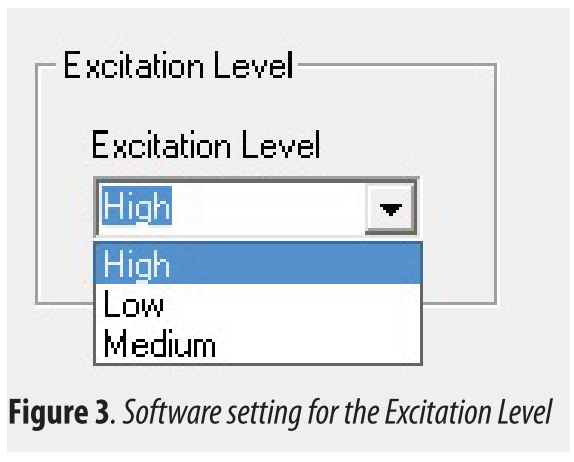
The excitation level can be adjusted for a given experiment under the Timing Setup tab. Use the drop down menu under Excitation Level to adjust the level to High, Medium, or Low (Figure 3). Once the experiment is run, using New From Current or New From Existing will save the desired excitation level. If the New From Template option is used, the default will revert to High.