
Newsletter #8

KinExA Concentration Measurements
The main use of KinExA technology is to determine tight affinities under physiologically relevant conditions but it can also be used for concentration immunoassays in a variety of sample matrices. This technique can be advantageous for many different applications; from serum and plasma measurements to environmental toxin detection.
In particular, therapeutic drug monitoring (TDM) is a practice that focuses on monitoring and sampling patient blood to determine drug concentrations in a clinical setting. It is believed that there is a definable relationship between dose and plasma/blood drug concentration, which is directly linked to therapeutic effects.1 While there are many factors that need to be taken into account when interpreting results, the ability to measure very low concentrations with KinExA can help researchers measure drug concentrations in an accurate and cost effective way.
In a recent publication,2 researchers measured the plasma concentration of Afatinib. The use of the KinExA for this measurement allowed for a lower limit of quantitation and better coefficient of variation when compared to other methods. A simpler procedure and convenience also supported the use of KinExA over conventional chromatographic assays.
In another study,3 the high sensitivity of KinExA employed the use of very small volumes (~1 μL) of plasma samples for analysis. Researchers also proposed that the high accuracy and automated analysis can be used to facilitate pharmacokinetics, pharmacodynamics, and TDM of therapeutic antibodies.
While the main use of KinExA is to determine affinity and kinetics, it is great to see researchers exploit the sensitivity and versatility of KinExA in a clinical setting.
- Kang, J. Lee, M. 2009. Overview of therapeutic drug monitoring. Korean J Intern Med. 24(1):1–10. doi:10.3904/kjm.200921.1.1
- Darwish, IA., et al. 2019. Development of two different formats of heterogeneous immunosensor. Scientific Reports 9:14742. https://doi.org/10.1038/s41598-019-51288-5.
- AlRabiah, H., et al. 2019. Automated flow fluorescent noncompetitive immunoassay for measurement of human plasma levels of monoclonal antibodies used for immunotherapy of cancers with KinExA 3200 biosensor. Talanta 192:331–338. doi:10.1016/j.talanta.2019.09.014.
Anti-His Secondary Antibody
The sensitivity of KinExA is attributed to the method of detection. This is why having a good fluorescent antibody is crucial. In some cases, the constant binding partner (CBP) is an IgG and detection is easily achieved with the use of commercially available fluorescent anti-species antibodies. In other cases, the CBP is a protein with purification tags such as biotin or histidine. A biotin-tagged protein is easily detected with fluorescent streptavidin. Labels for his-tagged proteins, however, have been expensive and quite inconsistent in their ability to effectively perform across different his tagged molecules. It is unclear why these antibodies bind differently, but it could be due to the location of the his-tag.
Over the years, we have tried a variety of anti-his antibodies for detecting his-tagged molecules. Where one seemed to work well for a particular his-tagged molecule, it failed to work with another. Recently, we tested SouthernBiotech’s Anti-His-Tag Antibody and, so far, it has proven to be a superior antibody at detecting his-tags.
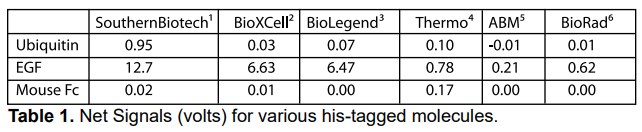
For testing, Ubiquitin (N-terminal his-tag) or EGF (C-terminal his-tag) was coated onto beads. Anti-his antibodies, at a molecular concentration of 1 nM, were passed over the bead column and the fluorescent signal was measured. We also tested each antibody against an untagged mouse Fc column to check for any cross reactivity. Table 1 shows the results.
For both his-tagged molecules, the SouthernBiotech antibody was superior for detection and had low cross reactivity.
Since this label works so well in our lab, we want to make it easy for our customers to try as well. SouthernBiotech is willing to offer our customers a special 10% discount on their first order of anti-his label. To get the discount, use the coupon code “Sapidyne” at checkout. Discounts are eligible until March 31st, 2020. We hope you have as much success with this antibody as we have.

For more information regarding SouthernBiotech’s Anti-His Antibody, refer to www.southernbiotech.com/His-Tag.aspx.
Antibodies Tested
- SouthernBiotech Anti-His-Tag-Alexa Fluor® 647. Catalog # 4603-31.
- BioXCell ReadyTag Anti-6-His. Catalog #RT0266. Note: Primary labeled in house.
- BioLegend Purified Anti-His Tag Antibody. Catalog 652501. Note: Primary labeled in house.
- ThermoFisher Scientific 6x-His Tag Monoclonal Antibody (HIS.H8) Dylight 650. Catalog # MA1-21315-D650.
- ABM Anti-His Tag Antibody. Catalog #G020. Note: Primary labeled in house.
- BioRad Mouse Anti Histidine Tag. Catalog# MCA1396GA. Note: Primary labeled in house.
Spotlight
KinExA Manual Available Online
We are excited to announce that the KinExA Manual is now available on our website! It covers every KinExA instrument to help you get the most out of your research.
The manual provides instrument overviews, a thorough introduction of KinExA Pro Software, details of data analysis, experiment setup/tutorials, and hyperlinks to popular tech-notes and how-to-guides.
Visit sapidyne.com/kinexa-manual to download.
KinExA Enters Korea with GREENics

In an effort to spread KinExA knowledge and to help better serve users in the region, we are pleased to announce our partnership with GREENics. GREENics is the exclusive KinExA dealer for Korea and instruments are now available for purchase or rental in the country.
GREENics was founded in 1983 and, during the last 36 years, has focused on supplying and servicing products to various industries and educational institutes. They are one of the largest distributors of scientific and analytical instruments in Korea. Part of their success comes from a sincere commitment to customer satisfaction that ensures both quality support and innovation, which aligns well with Sapidyne’s business philosophy.
This new partnership will help spread our industry-leading sensitivity throughout Korea and bring solution-phase affinity, kinetics, and concentration analysis to researchers within the country.
Ask the Inventor
Question
How is cell expression level determined with KinExA and how does it compare to soluble titrant activity?
Answer
In KinExA, expression level and titrant activity are both calculated from the best fit concentration found in the analysis. For an intuitive understanding of how concentration is determined in KinExA analysis, consider the simulated high ratio curves shown in Figure 1.
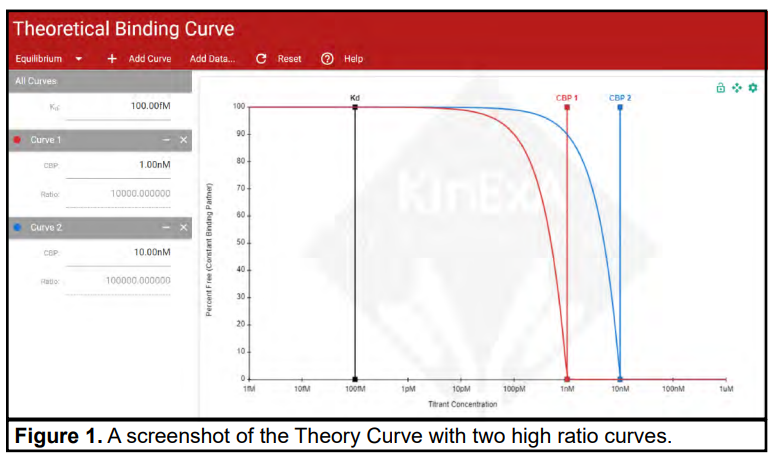
Notice that both curves approach zero Percent Free CBP at a Titrant concentration almost equal to the CBP concentration of the curve. In other words, the 1 nM CBP curve reaches zero Percent Free CBP at 1 nM titrant concentration. Imagine we had curves shaped like these but no labels on the x axis, if we believe our CBP concentrations (i.e. our reference) are 100% active then we can use either or both curves to determine the concentration on the titrant axis. Likewise, if we use our Titrant concentration as the reference, we can confidently set the active CBP concentration.
Figure 1 is an extreme example used to illustrate our point about concentration, we rarely measure such high ratio curves. In ordinary cases the shape of the entire curve, as well as the spacing between multiple curves, is analyzed by using the N-Curve Analysis and a best fit concentration is determined.
Once we determine the best fit concentration, we can use it to calculate the activity of a soluble system or the expression level in a cell system. For soluble systems it is a straightforward comparison – look at the measured concentration vs. the entered concentration. For example, if the entered concentration was 1 nM, and the measured concentration was 900 pM, the titrant activity will be 90%.
In a cell system we use the measured titrant concentration along with the entered cells/mL concentration to calculate the molecules per cell using this equation:
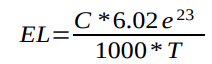
Where:
EL: expression level (molecules per cell)
C: measured titrant concentration (molar, or moles per L)
6.02e23: Avogadro’s number (molecules per mole)
1000: used to convert mL to L and align units
T: entered titrant concentration in cells per mL
It is important to keep in mind that both the Kd and activity are determined relative to the reference concentration. If the reference concentration is incorrect the Kd and activity will be incorrect to the same degree. This is still better than fixing both concentrations which can result in much larger errors in the Kd. An example of this is given in TN229 KinExA Analysis.
I would also like to mention that the binding model used for cells is different than the soluble model (CBP with all binding sites free in solution is detected, see TN211 Whole Cell Assay) but the fitting and limitations described in TN229 still apply.
Finally, Figure 1 is a reproduction of Figure 3 in TN220 Theory Curve. If you are not familiar with this Tech Note I highly recommend you work through it using the live Theory curve (available on our website and in our KinExA Pro software). The latest versions of the KinExA Pro software include a Ratio Demo in the Theory Curve with a slider allowing you to vary the ratio (CBP/Kd) from 0.001 to 1000 while the curve shape updates in real time.
Geek Corner
4000 Signal Output
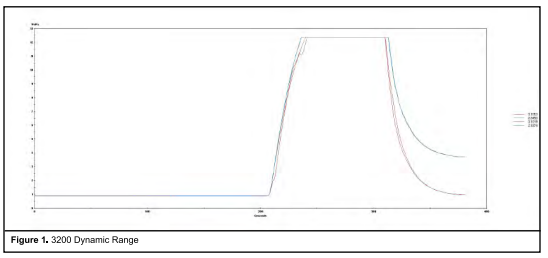
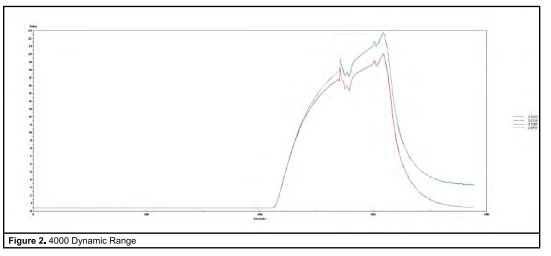
While there are several differences in the software between the 3200 and 4000, one difference that we have had very positive feedback on is the increased dynamic range of the signal readings. With the 3200 instrument, the maximum signal level is around 12 volts. The 4000 instrument can measure signals up to about 33 volts. This allows recording of the signals during the label peaks that can be cut off on the 3200.
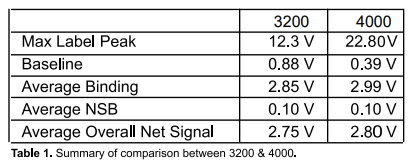
Figure 1 and 2 is a comparison between a 3200 and 4000 running the same materials at the same concentrations. The samples were 100 pM anti-digoxin and buffer only (for NSB). Label was goat anti-mouse DYL650 at 3 μg/mL. As you can see in Figure 1, the signal maxed out at about 12 volts for the 3200, but continued higher for the 4000 in Figure 2. The overall binding signals were a bit higher while the NSB was a bit lower on the 4000. Table 1 summarizes the results, and includes the baseline level which is less than half the level on the 4000 compared to the 3200.
Tips & Tricks
Coating PMMA with Biotin
Biotinylated beads often offer the best solid phase for binding assays, whether you’re using a biotinylated anti-species antibody (as described in TN211) or titrant. This type of bead provides a large linear range while keeping NSB low, making it an excellent choice for many binding systems.
Our current procedure for biotinylated bead preparation (HG208) includes washing the beads after Step 1 and 2. To optimize this procedure, we decided to test if washing was necessary.
Following our How to Guide, we coated beads in two different ways. One coating used [5] 1x PBS rinses (after Step 1 and 2) and the other coating did not. For Step 3, a large 150 kDa Antibody was tested as well as a smaller 5 kDa protein.
Table 1 lists the reagents used for testing beads.
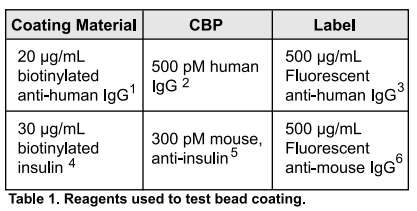
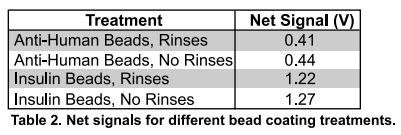
Table 2 lists the results of rinsing vs non rinsing between steps. Results indicate that rinsing the beads made no difference because the signals were not significantly different between the two treatments.
As a result of this study, our procedure will no longer include rinsing beads between steps. This means an overall faster procedure that will get you on your way to obtaining great KinExA Data!
NOTE: If coating biotinylated materials at a lower concentration than recommended, washing between steps may be necessary. This will ensure the biotinylated material only binds to the protein on the bead and not excess protein in solution.
- Biotin-conjugate Affinipure Goat, Anti-Human IgG (H+L). Jackson ImmunoResearch Catalog # 109-065-003.
- Human IgG, Whole Molecule. Jackson ImmunoResearch Catalog # 009-000-003.
- Alexa Fluor 647 Goat, Anti-Human IgG (H+L). Jackson ImmunoResearch Catalog # 109-605-003.
- Biotinylated Insulin. Sigma Aldrich Catalog # I2258.
- Mouse, Anti-Insulin. Fitzgerald Catalog # 10-130B, Clone M322213.
- Dylight 650 Goat, Anti-Mouse IgG. Sapidyne Instruments Catalog # 260320.