
Technology Note 210
Titrant Related NSB
Specific binding is the binding of a constant binding partner’s (CBP) active site to its target on the titrated binding partner. Non specific binding (NSB) is any other binding that occurs in the system that interferes or adds to the specific binding and complicates the measurement. This document will further explain titrant related NSB (TR NSB) and how KinExA® Pro software correct for it.
In a typical KinExA experiment the CBP and titrant bind in solution. Some of the free CBP binds to the solid phase probe, then a fluorescently labeled anti-CBP binds to the captured CBP on the solid phase. Those are all examples of specific binding. NSB refers to the possibility for the labeled anti-CBP, CBP, or titrant to stick directly to the solid phase. See Figure 1 for an illustration of different types of binding.

Figure 1: Illustration of specific and non-specific binding to the solid phase.
CBP and label concentrations are the same in all solutions, but the titrant is varied. If the titrant binds to the solid phase non specifically, the magnitude of NSB will be different in each of the sample solutions.
Usually NSB is thought of as a constant term that is subtracted from signals to get specific binding. TR NSB is an NSB term that is proportional to the titrant concentration.
When the “Titrant Related NSB” box is checked, the analysis includes the additional TR NSB term which is multiplied by the titrant concentration to give the TR NSB for that sample. The box should be checked when signals increase at high titrant concentrations. Figure 2 shows signal levels initially decreasing as the titrant concentration increases but begins to increase again at the highest titrant concentrations.
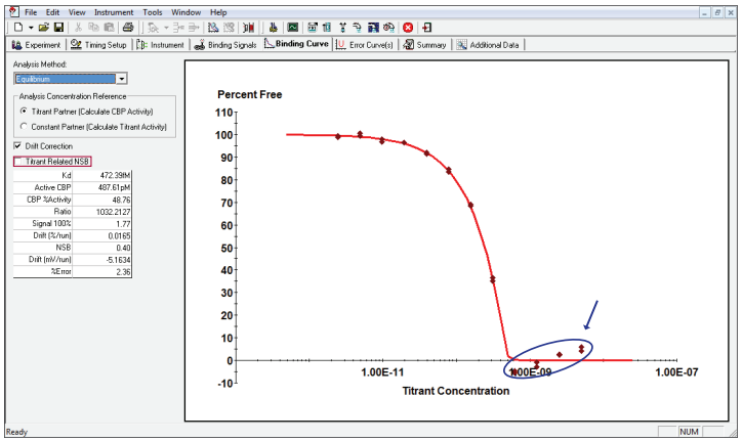
Figure 2: Example of analyzed data that appears to have TR NSB.
The TR NSB signal can be computed at any titrant concentration by multiplying the reported TR NSB term by the titrant concentration. In Figure 3, the TR NSB at 1 nM titrant is computed to be 3.15 e-2 volts or 31.5 mV.
Usually, checking the “Titrant Related NSB” box does not significantly change the Kd or Active CBP but it can sometimes tighten up the confidence intervals and improve the visual appearance of the fitted data.
Figure 3: Example of data from Figure 2 analyzed using TR NSB correction.