
How to Guide 232
Sample Preparation for an Equilibrium Experiment
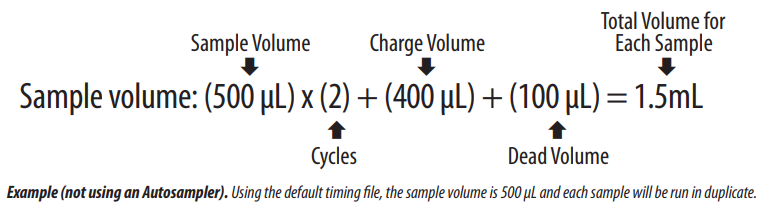
Step 2: Sample Buffer Preparation
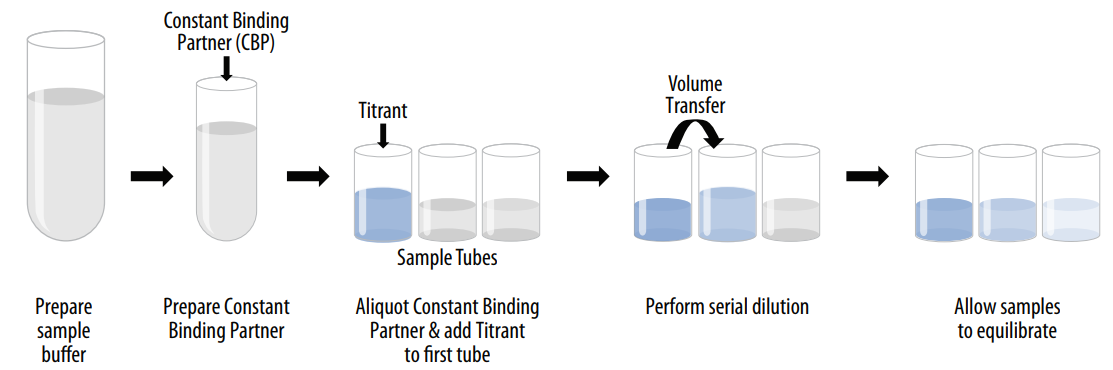
Typically the sample buffer is the same as the running buffer with 1 mg/mL BSA added to reduce nonspecific binding. Sample buffer is used to prepare the experiment samples as well as label solution.
Step 3: Constant Binding Partner Preparation
For an equilibrium experiment, the Titrant is serially diluted in a background of constant binding partner (CBP). Prepare a working CBP solution in sample buffer at the desired concentration and volume. Aliquot the CBP into each sample tube. Make sure to aliquot extra volume in the first tube for the serial dilution.
- e.g. 3 mL in tube 1 and 1.5 mL in all other tubes for a two fold dilution.
Step 4: Serial Dilutions
Add Titrant to the first tube to achieve the desired starting Titrant concentration. Avoid diluting the CBP significantly. If dilution by more than a few percent cannot be avoided (the Titrant stock is at a low concentration) then the CBP should be supplemented to bring it back up to the correct concentration (see notes).
Mix the tube thoroughly and transfer the appropriate volume to the next tube. Repeat this process for all tubes except the last tube. The last tube should be reserved for CBP only.
Step 5: Equilibration
Allow the samples to equilibrate at the desired temperature (see notes). The amount of time needed to reach equilibrium will depend on the Kd, kinetic constants, and temperature. Once the solutions are at equilibrium, the experiment can be started.
Notes:
CBP Concentration Error
- If the volume of the Titrant added to the first tube is a significant fraction of the total volume of the tube, extra CBP can be added to this tube to bring the CBP concentration back up to the nominal value. For instance, if 100 µL Titrant is added to 2 mL of a 10 pM CBP solution, the final concentration of CBP in solution is now 9.5 pM. To account for the dilution, extra CBP should be added to only the first tube (and not subsequent tubes) to restore the CBP solution to the correct concentration.
- When deciding whether to correct the CBP concentration in the first tube, bear in mind that the concentration error will be diluted (reduced) in the serial dilution process. For the example given, if uncorrected, the CBP concentration in the first tube will be 9.5 pM, the next tube will be 9.75 pM, the third tube 9.875 pM and so on. If these points are in a fully inhibited portion of the curve, they will not cause any error in Kd determination. What is “significant” depends on the experimenter and the goal.
Temperature
- Samples should be run at the same temperature as the equilibration temperature. If the samples are run at a different temperature, the samples will start to shift toward a new equilibrium for the new temperature. It may be necessary to place the entire instrument in an incubator or cold room for certain temperature studies.
Alternative Sample Preparation Techniques
KinExA® is a registered trademark of Sapidyne Instruments Inc.