
How to Guide 276
Streptavidin Coated Glass Beads
How To Guide 276 • HG276R1 • 18 Jun 2025 • © Sapidyne Instruments Inc.
For biotinylated molecules, covalently coupled Streptavidin Glass Beads are available as a solid phase for KinExA® experiments. Streptavidin Glass Beads can be functionally coated at a much lower concentration (down to 5 µg/mL) which can be helpful when material costs are high.
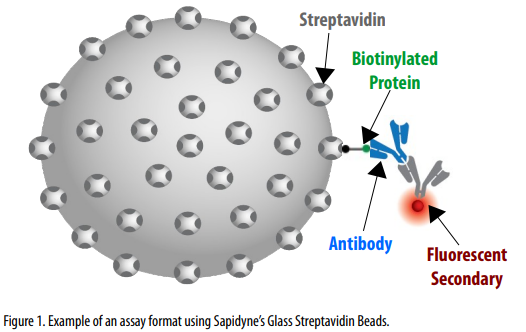
The length of the linker arm on the biotin provides more space, allowing the biotinylated molecule to interact with and capture the solution molecules freely (Figure 1). For cases where a biotinylated form of your molecule is not readily available, easy-to-use Biotinylation Kits can be ordered from Life Technologies’ website targeting a number of different reactive groups (search “Avidin-Biotin Handbook”).
Sapidyne offers precoated Glass Streptavidin Beads for purchase (446101). There is no need to remove the supernatant or block the beads, as that has already been done for you. This makes coating the solid phase easy, fast, and efficient. If you would like to coat your hard beads with streptavidin yourself, see Biotinylated Coating (HG208).
Optimal Concentrations
In general, for Streptavidin Beads, the optimal concentration of the selected molecule is 10–30 µg/mL. However, small molecules may only need to be at a concentration of 5–10 µg/mL. This quantity of coating material is suggested as a good compromise between signal and material. Coating with more material will not significantly increase the signal; however, coating with less will decrease the signal and the linear range of usable signals. For more information on linear range, see Linear Range (TN224).
Coating Protocol
- Remove the beads from the freezer and allow the Streptavidin Beads to warm to room temperature.
- Prepare 1 mL of 5–30 µg/mL biotinylated molecule in 1x PBS, pH 7.4, 0.02% NaN₃ with 10 mg/mL BSA.
- Aliquot the biotinylated molecule coating solution into the vial containing the Streptavidin-Coated Beads. Ensure that the beads are suspended in the coating solution.
- Rotate beads for 30 minutes at room temperature or overnight at 4°C. Sapidyne recommends using a Tube Rotator (840751).
Note: If experiencing high NSB, washing the beads using sample buffer (1x PBS with 1 mg/mL BSA) before coating with the desired molecule may help.
KinExA® is a registered trademark of Sapidyne Instruments Inc.