
How to Guide 208

Biotinylated Coating

How to Guide 208 • HG208R5
30 May 2025 •  © 2025 Sapidyne Instruments Inc.

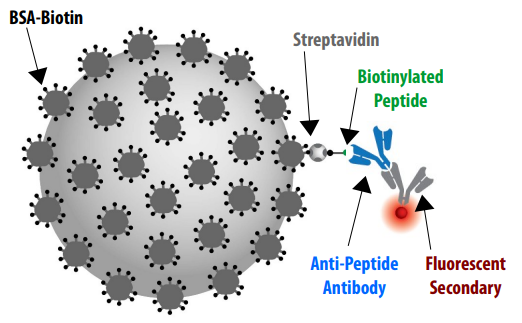
In some cases it is advantageous to use a biotinylated form of the Titrant for the solid phase. The linker arm to the biotin can expand the space between the molecule and the solid phase. The additional space allows the molecule more freedom to interact with the molecules in solution (Figure 1). A biotinylated form of the molecule may be readily available, or it can be biotinylated with simple to use kits. Different kits, targeting different reactive groups, are available from Life Technologies’ website (search “Avidin-Biotin handbook”). In these cases, using a biotinylated form of the molecule is sufficient and sometimes preferred as the capture reagent. Hard Beads1 can be coated with biotinylated molecules using the following protocol.

Sapidyne offers precoated Glass Streptavidin Beads for purchase (446101). To skip steps 1 and 2, see Streptavidin Coated Glass Beads (HG276).

Step 1. BSA-Biotin Coating

  1. To [1] vial of hard beads, add 1 mL of BSA-Biotin coating solution. This solution consists of 20 µg/mL of BSA-Biotin2 Conjugate in 1x PBS, pH 7.4, 0.02% NaN3. Make sure the beads are fully suspended in solution.
  2. Rock/tumble bead vials at room temperature for 1 hour or overnight at 4°C. Sapidyne recommends using a Tube Rotator (840751).
  3. Allow the beads to settle or pulse centrifuge at a low speed to pellet the beads. Discard the supernatant without disturbing the settled beads.

Step 2. Avidin Coating

  1. Add 1 mL of Avidin coating solution. This solution consists of 100 µg/mL Neutravidin or Streptavidin3 coating solution in 1x PBS, pH 7.4, 0.02% NaN3 with 10 mg/mL BSA4. Make sure the beads are suspended in the coating solution.
  2. Rock/tumble bead vials at room temperature for 1 hour or overnight at 4°C.
  3. Allow the beads to settle or pulse centrifuge at a low speed to pellet the beads. Discard the supernatant without disturbing the settled beads.

Step 3. Biotinylated Molecule Coating

  1. Prepare 1 mL of 15-30 µg/mL biotinylated molecule in 1x PBS, pH 7.4, 0.02% NaN3.
Note: Quantity of coating material is suggested as a good compromise between signal and material. Coating with more material will not significantly increase the signal, however, coating with less will decrease the signal and the linear range of usable signals. For more information on linear range, see Linear Range (TN224).
  1. Aliquot the biotinylated molecule coating solution into the vial containing the Avidin-Coated Beads. Ensure that the beads are suspended in the coating solution.
  2. Rotate beads for 30 minutes at room temperature or overnight at 4°C.

Figure 1. Example of an assay format using biotinylated-coated beads.

1. Glass Beads Pack of 10: Sapidyne (440425). Polystyrene Beads Pack of 10: Sapidyne (442178). Note: Sapidyne Does not sell PMMA Beads.
2. BSA-Biotin: Millipore Sigma (A8549-10MG).
3. Streptavidin: Jackson ImmunoResearch (016-000-114).
4. Bovine Serum Albumin (BSA): Sapidyne (2A3017).

KinExA® is a registered trademark of Sapidyne Instruments Inc.